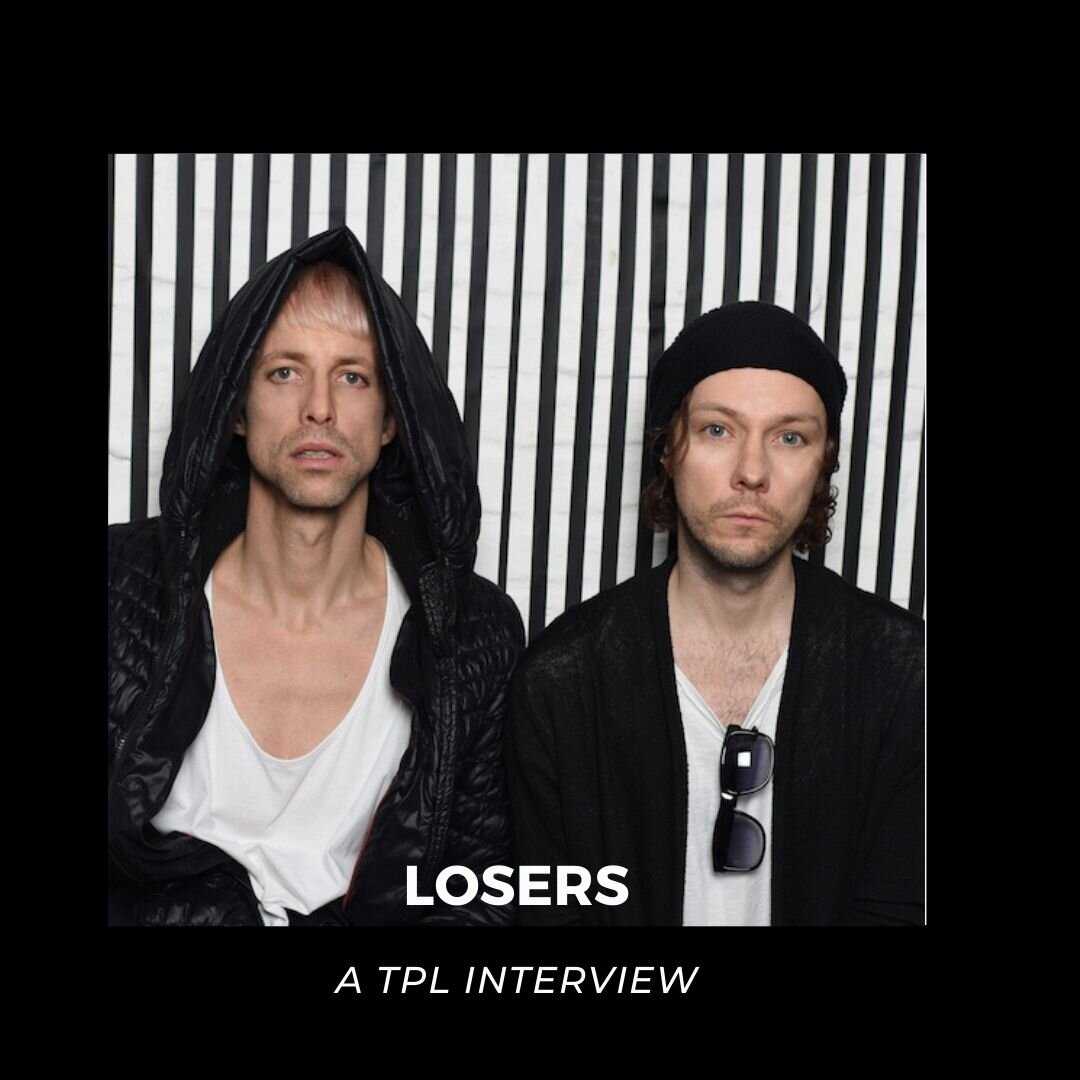
INTERVIEW: Losers

Losers
The Photo Ladies Interview - by Emily May
Photo credit: Ben Madle.
All questions answered by Tom Bellamy.
Sometimes you have to experience the dark to see the light, and for the UK genre-defying band Losers, they have re-emerged from a dark period having found their light. The band was formed in 2007 by Eddie Temple-Morris and Tom Bellamy as a remix project. The addition of guitarist Paul Mullen in 2010 saw the band veer away from dance-oriented music to more guitar-focused rock music and they became hailed by critics for their ability to blend the sounds of indie electronic music and guitar rock. Their music has been used in dozens of TV, film, videogames, and sports placements including Game of Thrones, The Blacklist, Hercules, The Killing, and as the official theme music for BMX Championships London 2012 Olympic Games. Two albums into their career, a desire for inspiration led them to move to Berlin, where they signed a publishing deal with BMG. Although they experienced momentum as a band in their Berlin studio under the production of Bellamy, they found themselves in a downward spiral as a band around the release of their 2016 hit album How To Ruin Other People's Futures. Although the album received critical acclaim, it was a low point for the band. “How To Ruin…was angry and bitter and resentful,” Bellamy explains. “It was a difficult time for us as a band and the music naturally reflected that. After pain comes transformation and so our music transformed with us. We allowed light to come in and the music began to have a completely different energy. If How to Ruin…was pig-headed and enraged in a corner, our new music looks to the world with open arms, embracing the entire spectrum, confident and composed.” In February of this year, the band released their cover of the Tears For Fears hit "Shout", giving it a more somber and dark sound. “All three of us are huge fans of Tears for Fears and "Shout" is just a classic,” says multi-instrumentalist Tom Bellamy. The song was prominently featured in the hit TV show A Discovery of Witches (S2: Ep 4) on Amazon Prime, AMC+, Sundance Now, and Shudder. “After the last album [2016’s critically-acclaimed How To Ruin Other People's Futures], we felt it would be creatively rewarding to deconstruct some of our favourite songs. We found that this was a great way to learn about how other people make music, to absorb some of their ideas and in turn help us to develop our own songwriting. We went back to school!” The darkness and pain that they have experienced as a band have given way to enormous growth and transformation, with their songs sounding more expansive and balanced than in the past. With big plans and new tracks plotted for release throughout the year, Losers are ready to regain their position at the forefront of the alternative rock world. “We grew up a bit, took some time to reflect and we wrote enough songs to realize that we were more eclectic than ever and that was a pleasant challenge for us to have," says Bellamy. “We want to take our fans on an interactive, genre-bending audio-visual expedition via new and innovative platforms which we hope to announce soon. We will be setting up live performances from the studio, ‘behind the music’ studio breakdowns, and giving away remix stems amongst other things to make sure we reward our fans after such a long time away. Very exciting times ahead indeed.” They most recently released their latest single "Lost In Translation", about reconnecting to ourselves and the world around us. “Life can feel so lonely when we see other people and things as separate to ourselves, trying to escape from something that didn’t exist until we created it,” says Bellamy about their new single." "The track is about feeling not at home, no matter where you are or who you’re with, but then realizing that home is within. It’s not until we step back and see ourselves as not separate from the world, but in union with it, in love with it, that we can really see beauty. It’s so important to remember to pause and not to dwell on the negative narratives we all tell ourselves.” With plans to perform their live shows as a 2-piece going forward and work to maintain the new momentum they are building, Losers have shown they are back and ready to dive headfirst into their new music and innovative fan experiences. Losers are DJ Eddy Temple-Morris, multi-instrumentalist Tom Bellamy, and guitarist Paul Mullen. You can connect with Losers via the following links.
Website | Facebook | Instagram | Twitter | Spotify | iTunes/Apple Music | YouTube | Bandcamp
Losers was formed in 2007 and evolved from dance-oriented music to a guitar rock sound when Paul joined in 2010. Having always been fans of bands who "reinvent the wheel" and push the envelope in terms of their sound, what has driven your evolving sound as a band over the years?
What drives us is our passion for music. The joy of experimenting with sounds we’ve never used before and put together different combinations of instruments to create new soundscapes. We still get such a buzz from creating. It’s highly addictive!
After releasing your first 2 albums, you made the decision to move to Berlin to be more inspired and signed with BMG Germany. What can you tell me about that decision to move to and live in Berlin and what inspired you the most about the city? What can you tell me about your Berlin studio?
Living in London simply wasn’t sustainable for us. Berlin was affordable and of course, it was full of new inspiration. The electronic scene definitely had an impact on us. We didn’t go to clubs much but it’s everywhere you go. It just soaks into your veins. Our studio is in a high-rise building on the outskirts. It’s home to probably around 200 studios and rehearsal rooms. It’s incredibly inspiring. There’s never a quiet moment. If you pop your head out the window you get techno mixed with classical mixed with psychedelic rock mixed with opera. It’s amazing.
You experienced a tough couple of years as a band around the time of your third album, How To Ruin Other People's Futures, which led to a metamorphosis for the band. In what ways did the pain and difficulty of that time lead to the transformation of the band and your music? What has it been like for you to let the light in and give new energy to your music?
We live our music. It’s a blessing and a curse. I often say that pain is also another word for growth and we had a lot of growing to do. I personally got too attached to an image of myself that I don't want to let go of. The pain is in the "not wanting to let go". Anyway, we shed some skin and we came out the other side feeling a lot more positive, focused, and energized. It had a huge impact on how we addressed our new songs.
Your music has been featured often in television, film, video games, and sports placements. What has that been like for you as a band and do you have any other opportunities coming up?
We’re incredibly grateful to have had our music synced to visuals so many times. It’s quite unbelievable. The best part was that we never wrote for that purpose, we just wrote for ourselves and music supervisors just liked what they heard. It meant that we could pay for our studio costs and stay afloat during a time when the music industry was crippling for musicians in terms of making money from selling records. There always seem to be opportunities ahead.
In February of this year, you released your cover of Tears For Fears "Shout", with the thought that it would be creatively rewarding to deconstruct some of your favorite songs. You've said it was a great way to learn about how other people make music, absorb some of their ideas, and to help you develop your own songwriting. What did you learn in the process? What inspired your darker take on the song and what can you tell me about having the song featured in the show A Discovery of Witches?
"Shout" is an epic song. It’s full of ideas but when you break it down you realize you can take lots of the elements away and give the essence of the song even more presence. It shows the strength of a great song when you can just take the vocal and put it with a simple piano or guitar part and it still sounds great. That’s essentially what we did. I wouldn’t say our version is dark but it is stirring. I find it very emotional. That just came in the moment from the energy in the room. We were honoured to have it used in A Discovery of Witches.
You most recently released your new single "Lost In Translation", which you've described as a reaction to feeling overwhelmed and disconnected from the world around you. What can you tell me about the song and what it means to you? How did you come to feel a sense of union and connection with the world around you rather than feeling separate from it? What effect do you feel Covid has had on the way in which you, and the world in general, have felt connected to others and the world?
I’ve been reading lots of books about consciousness and spirituality. Listening to people like Ram Dass or Thich Nhat Hanh, they helped me to understand some of the negative thought processes I had been having. As humans, we inherently need to connect, but most importantly we need to connect to ourselves. Covid was a good opportunity to look within when the outside world was so chaotic. I think everyone is yearning for connection and hopefully, there will be an explosion of that soon.
You have said that you usually write the music for your songs first and then the words, but for "Lost In Translation", the words came first. Having tried 3 different versions of the music, what was your process like for finding the right music to accompany the words and what led you to settle on the music you did?
Sometimes everything comes together in a day. You can write, arrange and produce the music and lyrics in a whirlwind and it almost took no thought or energy. Then there are other songs like this that take time to sculpt. That’s just the way it goes. After trying various other styles of music, this version just felt right. Music is a feeling. There’s no right or wrong. It’s all about vibe.
How do you feel that working with long time collaborators such as Damian Taylor and Dan Austin has expanded your sound and given it a new sense of balance?
Those guys are both legends. They do things with our productions that blow our minds. We’re incredibly lucky to have them on board. We know our limits as mixers and these guys just have the skills to take music to an incredibly high level.
You have said you will be releasing new music on a regular basis throughout the year. What inspired your decision to release music as a stream of tracks rather than as an album?
To us, everything about releasing songs individually makes sense to us. From a creative point of view and also from a consumer point of view. We can be more in the moment and we can be more reactive and more adaptable. There’s less downtime and there’s more momentum. It’s a win win for both us and our fans.
Going forward, you have revealed plans to focus on an interactive & genre-bending audio-visual experience via new and innovative platforms. One such experience is your new Behind The Music Series Webinar. What can you tell me about the idea behind the webinar and what fans can expect? What other experiences do you have planned?
The idea for the webinars was to give fans an insight into our world. I used to love listening to producers go through mixes on a desk. I wanted to do the same and maybe inspire someone else. It’s an opportunity to connect on a deeper level with our fans. We will also be releasing a live track every 6 weeks and a playlist of songs that inspired the track.
What led you to decide to make the live band a 2-piece going forward? What can people expect from future live shows?
We wanted something new. We’d done the whole 5-piece band thing but it felt like for the new sound, a stripped-back live setup was the way forward. We’re going to be making complete reworking of our songs in order to make a cohesive live set that will get people dancing. We wanna party :-)
You guys have been rejuvenated by a new perspective after a difficult era as a band and have a busy 2021 planned and a clean slate! What can you tell me about your new perspective and your goals as a band going forward?
We want to spread some joy and positivity. It’s time to connect, even if for now that’s through a computer.
What's next for you?
I’m going to have a cup of tea and then continue chipping away at this mammoth campaign we’ve set out for ourselves.

INTERVIEW: TREASVRE

TREASVRE
The Photo Ladies Interview - by Emily May
San-Francisco quintet TREASVRE has taken quite the journey to get to where they are today. Having all been friends since high school, it began as a side project for guitarists Jason Zaru and Julian Balestrieri. Evan Dulaney (drums/synth), Sabrina Simonton (keys/synths/vox), and Sam Pena ((bass/vox) later came on board and the band evolved to where they are today. Heavily influenced by the Bay Area scene that they all grew up in, the dedicated musicians that they saw perform night after night inspired them to develop their own musical skills. Although they all bring different influences to the band, the five members have always maintained a collaborative spirit and have decided that going forward, they will approach their songwriting process differently in order to better experiment with their sounds and better manage their time. Like with many artists, the Covid shutdowns altered the way in which the band released their music. They were in the studio just ahead of the shutdowns in early 2020 and, looking ahead to a year without events, decided to release their music a series of four 2-song EPs to give the songs the attention they deserve and have music to release throughout the year. Pairing their releases according to themes, they released "Devils/Echos" first, followed by "Too Late/One of Us", "Believe Me/Outside" and most recently "Heavy Arms/Secrets". Much of their inspiration as a band comes from the concept of the silver lining and finding that hopeful light at the end of the tunnel during challenging times. Having their four releases to focus on over the past year, as well as doing live-streaming events that helped them to reach a wider audience than they normally would have, helped them to combat the dread over thoughts of what their lives and music careers would look like on the other side of this. They have used the past year to evolve and grow both personally and musically. TREASVRE will be releasing two new singles this year, the first of which being set for release on April 30th, and are working on recording their new full-length EP. They also plan to release their new music video for "Devils" on April 2nd. A live band at heart, they are hoping to be back to playing live shows by the end of the year and then planning a tour. With plenty of new music on the horizon, TREASVRE is definitely a band to keep on your radar! You can connect with TREASVRE via the following links. Photo credit: Jeff Straw.
Website | Facebook | Instagram | Twitter | Spotify | SoundCloud | iTunes/Apple Music | YouTube | Bandcamp
You have all been friends since high school and all grew up in the Bay Area. You have said that the DIY hardcore and metal scene throughout Redwood City and Berkeley have always been a huge influence for you. What can you tell me about the music scene in San Francisco and The Bay Area growing up and how it influenced you? In what ways do you feel it shaped how you operate as a band?
The Bay Area music scene provided some of our first exposure to non-mainstream music and what it means to be a performing artist. Going to local shows as teenagers opened up our eyes to a world full of dedicated musicians who would stop at nothing to be able to create. We were immediately inspired by the people in our communities who got up on stage to play their hearts out for us and gave us a place to go where we felt like we could express ourselves. Sam remembers going to her first show in San Francisco where she saw The Phenomenauts perform, and what an amazing experience that was—the energy of the live performance, the excitement of the crowd, the feeling of the music pounding in her ears. Not to mention the sense of community. Those first local shows that we went to as teenagers captured our imagination, and compelled us all to spend more time developing our musical skills.
One way it’s shaped us as a band is we feel very tied to the Bay Area. We are all rooted here and spent the most formative years of our lives going to shows and experiencing the local music scene. As San Francisco grew more and more expensive in the 2010s, we saw many artists and musicians move to farther reaches of the Bay Area, southern California, and even different states. As a result, we’ve grown somewhat protective of our music community and felt like we have a personal responsibility to help it succeed. As a result, we have always been active in going to shows and supporting independent artists and venues. We know how important the local music scene was for us growing up, we want it to continue to thrive for new generations also.
Having all known each other since you were teenagers/young adults, what can you tell me about coming together to form TREASVRE and experimenting with different sounds to find your sound as a band?
TREASVRE took quite a journey to reach our current form. It all began as a side project of Jason and Julian, who were playing in a different band together at the time. Jason was the drummer for that band, but he wanted to devote more time to writing for guitar, and so the two of them started jamming out ideas in their free time.
Evan was the next logical addition to this new band. The three of them knew each other from growing up in the Bay Area and shared similar musical influences. As they fleshed out more ideas with Evan on drums and Julian and Jason on guitars, eventually they decided that a keyboard player would be a good addition to their evolving sound.
Enter Sabrina. She and Evan had been long-time acquaintances since they were 19 years old. They initially met while Sabrina was sharing an apartment in San Francisco with her childhood friend Cat Jones, who happened to be dating the bassist from Evan’s band at the time. Evan and Cat became close pals, and so he and Sabrina would see each other regularly throughout the years through their mutual friend. But it was still a bit out-of-the-blue when Sabrina got a Facebook message from Evan asking if she was down to jam. Having been primarily a solo musician up until that point, Sabrina jumped at the chance to join the band.
As a four-piece, Jason, Julian, Evan, and Sabrina began writing songs together and exploring different sounds. After some experimentation with synth bass and bass backing tracks, they finally came to the conclusion that a bass player was needed to complete the band. That’s when Sam came into the picture. Actually, Sam had kind of always been in the picture—she and Evan were dating and living together, and she and Julian were good friends since high school too. After a little convincing, she agreed to become our bass player and join Sabrina on vocals. And that’s when TREASVRE really started to become who we are today.
You have talked about how your songwriting as a band is a very collaborative process. What kinds of challenges have you faced in blending your different songwriting styles together or has it been a smooth process? What can you tell me about your desire to change your songwriting process with your upcoming music?
It definitely hasn’t always been a smooth process. We regularly have debates over which sound/vibe/direction we want to take a song, and it can be difficult to try to come to a consensus among all five of us. Our individual musical aesthetics actually blend together nicely. Even though we represent a variety of music tastes, there are several common threads tying them together: heavy guitars, lots of atmospheres, heartfelt lyrics, and rich synth textures, to offer up some examples. But having so many opinions at play during our songwriting sessions can get complicated, so we’ve decided to try a different approach. Instead of working on new music with every band member in the room, we are collaborating together in pairs and then recording ideas that we trade back and forth. So far, it’s going well, enabling us to be more thorough in our experimentation and more effective with our time.
You hit the recording studio last year right before the shutdowns. What can you tell me about getting creative with your release schedule and releasing the music you had recorded as a set of 4 separate short EPs, as well as the themes that surrounded each release? How did you decide the order in which to release each EP?
We literally wrote down all the songs we had recorded on a whiteboard and tried organizing them in various ways until it made sense. It was the beginning of the pandemic, and we were looking ahead at a year without events and wondering how we were going to promote all our new music. It made sense to space out short releases in order to give our songs the attention we thought they deserved, as well as get more mileage out of them during a time when we couldn’t perform live. We ended up pairing up our songs according to their themes: “Devils / Echoes” is about isolation and escapism; “Too Late / One Of Us” explores trust and betrayal; “Believe Me/Outside” tells two different stories about control and surrender; lastly, “Heavy Arms / Secrets” looks at two different approaches to letting go. We decided to kick off our release series with “Devils / Echoes” because we wanted to put our best foot forward, and we felt that those two songs really exemplified our music and aesthetic.
You recently released "Heavy Arms" / "Secrets", the 4th and final release in the series. What can you tell me about the songs? I read that "Heavy Arms" still represents the original message of the song when you first wrote it, but that "Secrets" went through many iterations before achieving its final form as a song. Why do you feel the two processes for the songs were so different?
“Heavy Arms” is the odd song out in our release series because it’s the only song with lyrics written by someone other than Sam or Sabrina. Our guitarist Julian is the primary lyricist on this track, and we all liked his original concept so much that we never really felt the need to stray from the song’s original version. Sure, we’ve tweaked certain parts over time, but we’ve never felt the need to rework it or make any major changes beyond the initial songwriting process.
“Secrets” was very different because the original concept for the song didn’t stand the test of time. Julian plays a role here too because he was the least satisfied out of all of us with its first iteration. After recording a demo and stewing on it for a while, Julian suggested we take a fresh approach at writing the vocals and offered up some rough ideas for a melody. Sabrina took his ideas and ran with them, and together they were able to finally craft the song into its current form. This was happening at a time in Sabrina’s life when she was going through some positive changes; she had plenty of inspiration, and a triumphant-sounding song like “Secrets” was the perfect venue for her to convey her journey through lyrics. Once we had the force of intention behind the songwriting, we finally got to a version we all felt good about.
Evan- You have a love for graphic design. What can you tell me about the artwork you have done for several of the releases and what inspired your designs? How would you describe your aesthetic?
Evan: While I did the final production of the album art, the concepts were definitely a collaborative effort. We knew that we wanted a common theme throughout the album covers, and we knew we wanted a surreal treatment that reflected the themes of each song, so eventually, we landed on the concept of closeups of the human form. First, we tinkered with taking photos, but those didn’t have the desired effect, so I jumped in and made them in 3D. Each cover features a 3D scan I was able to get using my smartphone using Sam as a model, and flowers that I designed myself. My aesthetic kind of bounces around depending on what I’m working on, but for this release series I’d say I was going for a surreal, tense, and dramatic feel for the cover art.
You have said that much of your inspiration comes from the silver lining-the hopeful light at the end of the tunnel during challenging times. Do you ever struggle to see that light? In what ways do the pain and beauty in life inspire you?
We do struggle sometimes, as all people do, to find the good in certain situations. Especially this last year, as we watched our city shut down and our favorite venues shutter their doors, it was difficult at times to imagine what our lives would be like on the other side. We were definitely fortunate to have our release series to focus on—having an ongoing project really helped us stay positive and motivated despite everything going on in the world. We’ve been touched by how our music has been received and inspired by our online community who came together and innovated new ways of experiencing music online. Through playing shows via online streaming, we’ve actually been able to make connections we never would have made before, with people from all walks of life and from all over the world! The point being, you can’t find the good if you don’t look for it. We really believe that perspective can make all the difference, even in life’s most challenging situations.
You have referred to 2020 as a big year of transitions for each of you and have said you shouldn't let the past hold you back from evolving as a person. How do you feel you have grown and evolved over the past year, personally and artistically?
We’ve made some adjustments to how we songwrite over the past year. Evan has transitioned from writing on guitar to using synthesizers instead, and Sam has also been experimenting with different writing styles outside of her comfort zone. Julian and Jason have both been putting a lot more time and thought into music, and working on being more intentional with their efforts. Sabrina has been taking vocal lessons and learning more about using her voice as an instrument, which has given her more confidence to try new things. We’ve become closer as a band in the past year as well, by being forced to really think about who we are and what our goals are.
On a personal level, the past year was a big wake-up call about what’s important in life and what we need to thrive as individuals. Not being able to socialize or do other activities freed up a lot of mental bandwidth for introspection, and we definitely found ourselves asking a lot of big picture questions. Another point of personal growth has been learning to adjust our expectations. 2020 didn’t turn out like any of us planned, and we had to let go of what we had envisioned the year to look like.
As tough as the past year has been for so many people, what does self-care look like for you? What do you enjoy doing outside of music?
Getting outdoors is definitely a big one for us. Whether it be hiking, bicycling, motorcycling, or playing catch in the park, just being outside really helps us feel better. We also love to explore by taking aimless walks, trying new restaurants, or trekking extra far just for a cup of coffee. The Bay Area is a truly breathtaking place and there is so much natural beauty where we live. We are truly lucky that we can go to the beach at a moment’s notice, or climb any of the 49 hills in San Francisco to experience an awe-inspiring view. We try to take advantage of it as much as we can!
What can you tell me about the two new singles you'll be releasing in the coming months, as well as the full EP you are hoping to release by the end of this year?
Release day is coming up quickly! The first single will be coming out on April 30th, more details on that to come. Our full EP is currently in the works and we are excited to watch it slowly come together. We wanted to be more intentional with this longer release, and really craft a story and a vibe that will be impactful to the listener. So, we are spending more time trying new things, fleshing out ideas, and thinking about what it is we’re trying to convey. Ultimately, we want to create a collection of songs that’s moving and memorable.
As a band that was very focused on live shows prior to the pandemic, what has it been like for you to not be able to perform for a live audience? What do you look forward to the most when live shows resume?
Performing in front of a live audience is one of the best things about being a musician, and there really is no substitute. We’ve sorely missed the feeling of the energy in the room when we play for a crowd, and the sense of community we got from being an active part of our Bay Area music scene. But the absence of shows has also had a strange upside, in that it forced us into the world of streaming and opened up so many opportunities for us that we probably wouldn’t have gotten otherwise. By playing online shows, we were able to meet people from all over the world and reach audiences we never would’ve reached before! It’s also helped us build our social media presence as that has been our primary tool for getting our music out there.
What we’re looking forward to most about the return of live music is the reopening of venues. Small independent stages are crucial to any local music scene and we can’t wait to be able to support them again! We’ll be busy going to plenty of shows as soon as they are up and running again.
What's next for you?
We’re releasing a music video for our single “Devils” on April 2nd! This film was an incredible undertaking involving a team of talented people lead by Bay Area independent filmmaker Michael Beltran. We are thrilled with how it turned out! After that, we will be releasing our next two singles, and we are planning to return to the recording studio over the summer to track our full-length EP. In the coming months, we’ll be busy writing new music for that release, and by the end of the year, we hope to be back to playing live shows. Once that happens, we’ll start setting our sights on going on tour!

INTERVIEW: LAU
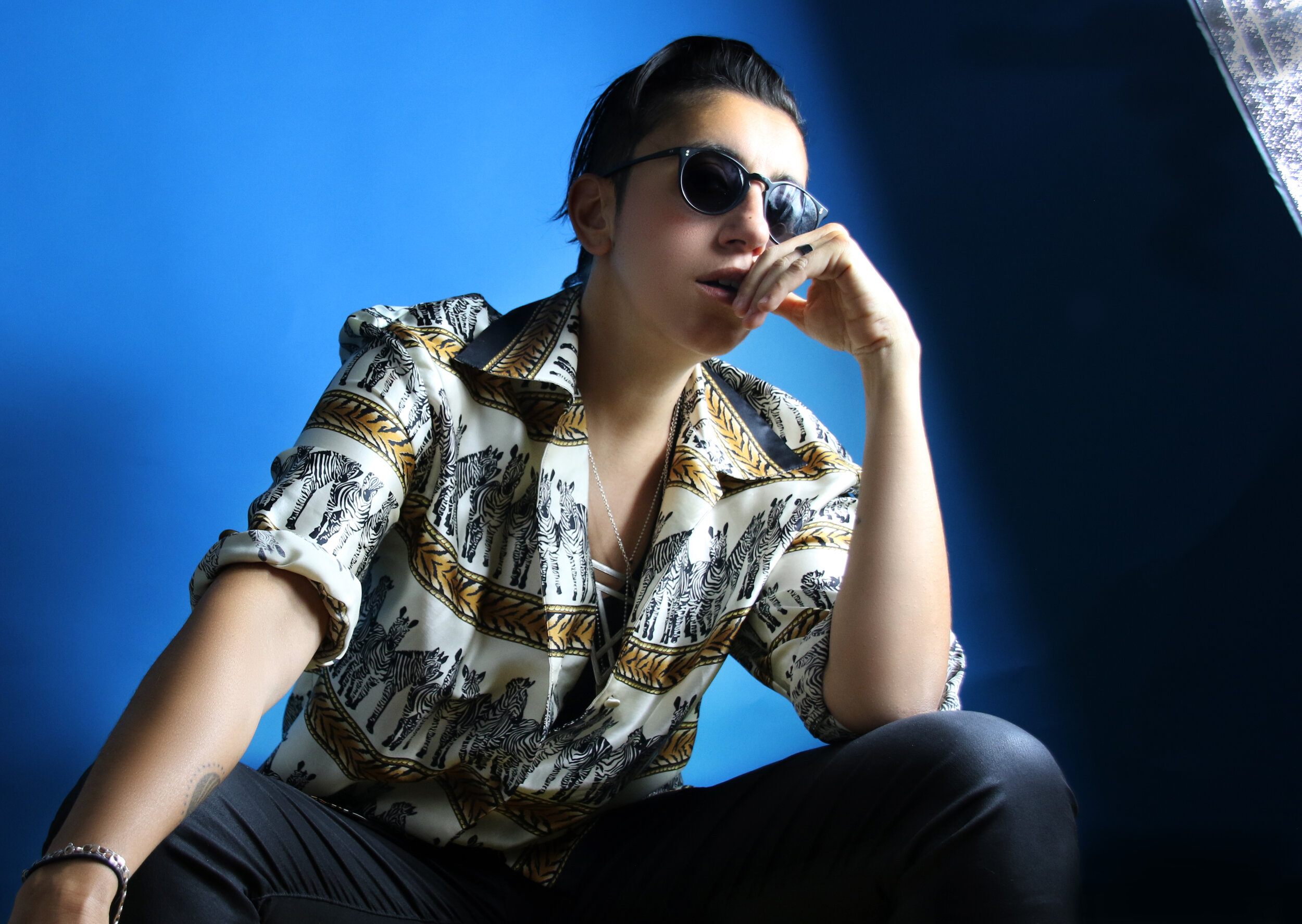
LAU
The Photo Ladies Interview - by Emily May
Photo credit: Yanny Tokyo
Music is often an outlet for expression, and for Argentian-born and Barcelona-based artist Laura Fares, better known as LAU, she channeled her emotions following the split from her partner of 9 years into her debut solo album Believer. “The whole album talks about everything I went through last year, breaking up after nine years… the disappointments, the lies, the heartache, the sadness, that sense of being completely lost and having to find yourself again,” she itemizes. Her love for synthwave/retrowave music has led her to blend New Wave, Sythwave, and Electro Pop styles with her own melodic hooks to create her sound. Having had a love for music from a young age, she taught herself drums and guitar at the age of 17, and following college in the UK, she became an in-demand songwriter and set out on tour as a session drummer for various artists such as Sam Sparro, Ricky Martin, and Taio Cruz. Fares spent many years behind-the-scenes, writing and performing for other artists, and with Believer, she has decided to start writing music for herself, showcasing herself as a solo artist. “Deep inside, I always knew I was a songwriter,” she explains, “but my career as a session drummer and DJ/producer took me to different places and ended up working with different artists. Now I think it's time for me to truly and openly express who I am, what I'm going through, and what I have to say. I hope some people will connect with that.” In addition to writing and performing music for herself and others, she is also the co-founder of the synthpop label Aztec Records, formed in 2010 with friend Ariel Amejeiras, which has launched the careers of NINA and Bright Light Bright Light, amongst others. In 2014, Aztec Music Publishing was formed as a way of managing and expanding the Aztec Records catalog more effectively to pursue placements in tv, film, and advertisements, and last year, the Spanish-speaking sub-label called Aztec Latin was launched. Fares recently relocated to Barcelona and has been busy recording some collaborations and getting her live show together, with the hopes that live shows will return soon. Believer was released on February 12th via Aztec Records on vinyl, cassette, and CD-R in an original and Deluxe edition. The Deluxe version of the album includes remixes by some of the top producers in the genre like Luke Million, Sunglasses Kid, Droid Bishop, Popcorn Kid, Maethelvin, Highway Superstar, and newcomer talent Austin Apologue and also includes an exclusive cover version of a Haim’s “Now I’m In It”, reworked by Friday Night Firefight. You can connect with LAU via the following links.
Facebook | Instagram | Twitter | Spotify | SoundCloud | YouTube | Bandcamp | Aztec Records
You taught yourself drums and guitar at the age of 17 and following college in the UK, you went off on tour as a session drummer for various pop stars. What can you tell me about starting out as a session drummer, as opposed to launching your own music career, and how the opportunity came about? What was it like for you to travel the world at that age, and what do you feel that you learned from your travels and experiences with other artists that have helped you in your career?
I was always fascinated by the drums, so to be a session drummer and tour the world was a dream come true. I moved to the UK in 1999 and I went to University to study music. As soon as I got my degree I got lots of auditions and started drumming for big acts like Sam Sparro, Taio Cruz, Big Black Delta, Ricky Martin, and others. Playing for major artists taught me a lot and was very inspiring. I met some incredibly talented musicians, visited amazing places, and played in some legendary stages and tv shows. It was a fantastic few years of my life as a session drummer, but I realized I needed (and wanted) to create something more permanent, something more "me". So I simultaneously started to develop my producing and songwriting skills with different projects.
You have discussed being drawn early on to the Synthwave/Retrowave scene and feel that the synth-pop sound is a nostalgic sound that immediately takes you back to your childhood. What does that nostalgia look like for you and how do you feel it presents itself in your music?
I think that characteristic 80s synth sound is always very present in my music. I grew up listening to Madonna, Queen, Tears for Fears, Roxette, and they really marked me as a songwriter. Strong melodies supported by lots of harmonies were always something important to me as a songwriter. I also love the aesthetic 80s element, it just brings lovely memories and I think it's timeless.
You recently launched your solo career, after years of writing, producing, and performing for other artists. You have said that a mistake you feel that you have made was not to believe in yourself earlier and to just now launch your solo career. Why do you feel that you lacked self-confidence before now and how do you feel that your experiences over the past year led you to decide that now was the moment to do so?
I think when you're a creator you put yourself in a vulnerable position, as you're exposing yourself and your emotions, and it's always easier to "hide" to avoid any disappointments, and looking back, I think I was kind of doing that subconsciously. I didn't have the courage to present myself as an artist back then. I guess I didn't really believe in myself fully... my voice, my looks, my age. It was a journey that took years... to finally believe in what I have to offer as a solo artist and to trust my voice and my craft. That's why I decided to call my debut album 'Believer'.
You recently released your debut solo album Believer, which deals with everything you have been through over the past year and breaking up with your partner of 9 years. What was it like for you, through the writing of this album, to go on the journey of finding yourself again? What have you discovered about yourself in the process?
It was a very cathartic process to write this album and to pour all my emotions into it. I always say it was like therapy to me. There are some songs in my album that made me cry for 2 weeks non-stop while writing them. But even though it was a painful process, I'm very happy with the final result and I hope people will connect with each song and the lyrics. Each track on the album portrays a different stage in that separation process, from the disappointment and initial disbelief to the more hopeful songs of acceptance and wanting to fall in love again. I finally realized that after all the pain, disappointments, and heartache, I was right where I should be. Life had taken me where I needed to be, to learn whatever I needed to learn about myself and about my music. To find me again after having "lost myself" in a relationship for so long.
What can you tell me about the artwork for Believer and how you met and came to work with illustrator Joe Cramer? What inspired the design?
There's a photo by Yanny Tokyo that I really wanted to use as the cover of the album, but I wanted an iconic 80s looking illustration, so I asked Joe if he could come up with something (he's also based in Barcelona). He did a fantastic job illustrating me and captured the vibe immediately, he got inspired by classic 80s album covers. I'm really pleased with the final result.
You have said that deep down inside, you always knew you were a songwriter. After writing for other artists for so many years, what has it been like for you to write and express yourself through your own songs? How do you feel the two processes differ?
It's been a very revealing and cathartic process, finally using my songs to express my own emotions and to connect with the audience in a more direct way. Finding out where my voice would take me and not holding back. This is a much more personal process now and puts me in a more vulnerable position, opening up my heart and emotions publicly, but it's all worth it. I loved writing for others, but sometimes it wouldn't sound exactly like I envisioned it, whereas, with my own album, I had complete creative control over the sound, lyrics, and aesthetic.
In 2010 you started your label Aztec Records with Ariel Amejeiras and in 2014, Aztec Music Publishing was formed as a way of managing and expanding the Aztec Records catalog more effectively to pursue placements in tv, film, and advertisements. What do enjoy about running your own label and what led you to expand into tv, film, and advertisements? What can you tell me about the Spanish-speaking sub-label called Aztec Latin that was launched last year?
It's been an incredible journey running a label with one of my best friends (and I still love it!). I got to learn a lot about the music business and how to develop artists and point their careers in the right direction. The label started as a passion project initially, and after a few years, we started growing as a business. We now employ over 10 people and have offices in the UK, Spain, and Argentina, and represent over 30 artists worldwide. The Publishing side was very important for us to grow as a business, placing music in tv, ads, film, and games and has allowed us to continue to invest in developing and releasing new talent. Last year we made the decision to launch Aztec Latin to release and promote Synthpop and Electronic music purely in Spanish and it's been going great, we're super excited about it all.
What can you tell me about your move to Barcelona and what you love and find inspiring about the city?
After 21 years in London, I felt that it was time to move on to a new place to have a fresh start, and Barcelona was the perfect choice for me. I have friends here, I speak Spanish, I love the warm weather, the beach, the food, the outdoor sports, so it was an easy decision to make. As much as I love London and I'll always be very connected to that city, I had to listen to my heart and make the change when was needed, so I can continue to be inspired, creative, and happy.
You recently released your first-ever music video for "True". What was the experience like for you and what can you tell me about the idea behind the video? Do you have plans to shoot more music videos?
We had lots of fun filming my first video. It was directed by Lluis Miras and we shot in Barceloneta Beach and in the Gothic Quarter, where I live. I always like to clone myself in my home-videos and we wanted to try the same concept for this one. It took 3 days to film all the scenes and the final scene where the ball hits my face nearly broke my nose... but we got the shot we wanted! We already started planning the next video, but I can't say much about it yet.
What do you hope people take away from your music?
I hope that my music will brighten up their day, or might make them want to dance or help them reflect about a certain situation. Whatever it is, I hope they connect with the music, the lyrics and the emotion I put into all my songs.
What's next for you? What are your goals, post-pandemic?
I'm recording some collaborations at the moment, and I'm starting to get my live show together, maybe do some streaming shows and I keep dreaming of touring again one day. Fingers crossed!

INTERVIEW: Mensa Deathsquad

Mensa Deathsquad
The Photo Ladies Interview - by Emily May
Having spent much of his life as a part of the Kansas City music scene, whether as a musician, band leader, label owner, or label manager, to name a few, Brandon Phillips encapsulates many different genres of music as a musician. From the ska-punk sounds of The Gagjits, the more aggressive, rock-based punk of The Architects, the Motown-flavored 60s pop sounds of Brandon Phillips and The Condition, or the alt-electro sounds of Other Americans, he has spent the past 25+ years steeped in the music industry. Most recently, Phillips has embarked on his first solo project, the darkwave/alt-synthwave band Mensa Deathsquad. With the past few years spent in and out of the hospital fighting illness, he released his first Mensa Deathsquad album Patient Zero in the winter of 2019-2020. He faced a challenging feat in releasing and promoting an album following post-operative infections and a pharmaceutical haze. The only thing he had to look forward to in the absence of tours, live appearances and music videos was the release date and album premiere. Although the emergence of Covid soon after dampened what should have been a successful album release, Phillips, upon release from the hospital, holed up in apartment to write his follow up album, Cyclist. The isolation and illness that he emerged from resulted in a garage-rock take on darkwave that is a perfect continuation of Patient Zero. He has released two singles from the upcoming album, due to be released on February 23rd. The first single he released was "Nothing Is Ever Enough", followed most recently by "Famous". “Don’t get me wrong. I don’t have some weird chip on my shoulder about famous people. I won’t pretend to be so urbane and sophisticated that I no longer have any use for people who are both great at what they do and well known for doing it,” says Phillips, when asked about the basis for "Famous." “That said, I loathe, detest and revile celebrity influencer culture so thoroughly that I believe it should be garroted to death at the earliest possible time and pushed into an unmarked grave,” he continued with a smirk, gritting his tightly-clenched teeth. Cyclist carries both a powerful music punch, a cultural rummaging through pop culture, and a run through his ever-evolving intellect. A knowing wink to fans of the seminal vampire flick The Lost Boys, “Join Us, Michael” is at once a seething appraisal of a world scorched and defiled by an older generation and a musical love letter to that pivotal ‘80s vampire movie soundtrack. “Leap Year (Chaos Reigns)” which began as a Siouxsie & the Banshees-inspired jam serves as Cyclist’s true north – the story of a drug-fueled wrinkle in time that brought the entire cyclical nature of existence into visibility one fateful night. “End Of The World” is a dance-floor nihilist electro-rock blending angular post-punk guitar with the nostalgia of neon synths and electroclash drums, while “Takes One To Know One” slowly approaches the thunderstorm of toxic relationships, soulful vocals, tech house kick drums, and grimy-as-hell bass. As a fitting conclusion to the tour de force through his psyche, Cyclist closes with yet another two-track charge, the swaggering post-electro sneer at celebrity social media, “Famous” followed by the throbbing Giorgio Moroder-via-Tech House cover of Iggy Pop’s classic “The Passenger.” “It was important to me that I cover ‘The Passenger’ as a letter of intent,” says Brandon. “The electronic music that I daydream about always has that Stooges layer of dirt and shop grease on it. That’s what I wanted for Cyclist.” With plans for a live stream event and the hope of some outdoor shows when the weather turns warmer, Phillips is ready to get back to touring. You can connect with Mensa Deathsquad and stay-up-to-date on the upcoming album via the following links:
Facebook | Instagram | Twitter | Spotify | SoundCloud | YouTube | Bandcamp
You've had quite a journey in sound as a musician over the years with your various bands, doing all different kinds of music. With regards to Mensa Deathsquad, what led you to want to go the EDM route?
Ok. So, the list of things I've always wanted to do but have never done is mercifully not that long. It's kind of a shortlist. The other things that were on this list, at one point or another, it was like I'd love it if I could come back in my next life as a party rock MC. Like a total Mike D style, or MCA...just that kind of MC, right? I just love it, but I won't do it. Like, I won't do it in this lifetime. There are just some pools I can't bring myself to jump in, either because I'm a coward or some other reason (laughs). Or, like, I'll never take up the violin because I'm aware that's a lifelong pursuit and I'm already a little long in the tooth to take up a new instrument. But with this, it was just doing something by myself, with just drum machines and a bass guitar and a keyboard. Can I do that? Of course, I can do that! And then there was a pandemic and it was like yeah, it's all I'm doing. That was just a thing I always really liked and I felt like there was certainly room for my voice there.
What was it like for you to do a project without any other band members since you have always been in bands?
That part is kind of fucked up, honestly! There's a membrane there that you kind of have to push through, or at least I did. And I'm going to go ahead and call myself out for using the editorial you when I actually mean me. That's like a thing I need to stop doing (laughs). So there was a membrane there that I needed to push through. In a band, you defer to some kind of democratic structure. There are votes and it's like nobody but me gets to vote on the lyrics but other people get to vote on this or that part of the arranging, or whatever. It's weird to suddenly have all of the decisions come down to me and it's unsettling. It's like I'm making these decisions about drums and it's like "You may not be the right guy but you'd better become him and grow into him real fast" (laughs). It was really weird because suddenly you can't just look and gather from the look on your bandmate's face whether or not what you're doing is cool.
You have said your love for the sounds of EDM was kind of hampered by the festival EDM formula that kind of bored you. Can you talk a bit about what it was you didn't like about EDM and how you went about creating a sound that was more you?
I kind of looked at festival EDM as a problem that I needed to solve. And I don't mean like I'm trying to solve this problem for the world like the world needs my version of EDM or whatever, but I needed to solve it for me. I don't want to pick on anyone in particular, but I could listen to somebody's set from some festival and it's like everything follows this pattern. It's like a shitty suburb. Every house is built on the same fucking floor plan, using the same stones and foundation and exactly the same stucco and countertops or whatever, and you end up with a whole neighborhood that looks like a Home Depot showroom. That's exactly how EDM was feeling, like that festival big room house. It felt like that to me and it felt like people were just hiding behind this architectural blueprint. It just lacked songiness. You'll have EDM producers that have awesome musical ideas but the musical idea that was awesome is about 4 seconds, so you don't really get a lot of development and there doesn't tend to be much of an arc, except for this really predictable romantic comedy or shitty action movie arc. I just found that really boring. Songs can do more than that and music can do more than that. A good song has a story arc that's kind of like a movie. There's a false defeat and you don't just go from tragedy to triumph. You go through phases of it and songs do that, but just DJ-produced EDM doesn't, usually. It's just "we're just going to keep recapitulating this drop". Which is like "Well, fine. But you're only going to have me for like 10 minutes", and then I'm sick and tired of it and I want to hear something else. In order to make it work, it's like I love those sounds. I love gnarly-sounding synthesizers and gigantic, stupid, in-your-face kick drums. Those things sound great to me. I was just like "Somebody has to make songs with this. I can't keep listening to non-songs.
You were in the hospital at the start of last year as your debut album Patient Zero came out. What was it like for you to try to promote the album at that time and then to right into Covid and the ensuing shutdowns that happened as a result?
It felt like getting mugged and it was the point in the mugging where you just have to, like, cover your head because they're just going to keep kicking you and you don't have a chance. Just cover your head and try not to take many shots to the face and hope that nobody shoots you or stabs you and that all you take is an ass whipping (laughs). It was like "Ok. Well, I'm fucked. I'm just going to cover my face and when the muggers are gone, I'll check for broken bones or whatever." That was pretty much how that felt, and that sucks. I hadn't really begun to recover from all of that, and it was really a mercilessly protracted process of one shitty secondary infection after the next, and going back to the hospital then back home then back to the hospital. I had barely started to recover from that when Covid hit and was like "Oh Jesus". I was already tired of being in the house and wearing sweatpants and all that kind of shit (laughs). I had already been essentially quarantined for like 4 months before Covid hit, and then Covid hit and it was like "Oh, wonderful. What do we have to do now?". I was like "I'm at least going to be quarantined for a few more months, so I guess I'm making another record. What else do I do with all of this pent-up energy but make a record?". I finished this record then was sitting on it like "What the hell do I do? Do you release a record in the middle of a pandemic?". It didn't really seem like anybody cared about entertainment that isn't like a Netflix series that will kill three nights of boredom. I wasn't sure if it was smart or not to put a record out in the middle of this disaster and sat on it as long as I could before I was like "I can't stand it anymore!".
How do you feel that the new album compares to Patient Zero?
Hmmmm. I can tell the difference between the sorts of compositions that I was attempting on Patient Zero and the sorts of compositions I was attempting on Cyclist. I feel like Patient Zero was an experiment and I was really trying to make them work. It was like whatever I had to do to make it work, like "I don't quite get how this works but I have to figure it out." I don't think I did a shitty job. I think I did a fine job. It's cool and it's a good record. But I think that what I learned from Patient Zero was what works really well...which parts of this idea of Mensa Deathsquad actually work well and which parts are still not quite baked. On Cyclist, I just tried to go with stuff I knew worked well. It was like "Ok. I really like this, so I'm just going to go with that and I'm not going to do some introspective journey of trying to figure out if it's actually good or what the artistic merit is." I was just going to do it because it works. It made it a little bit easier because now I'm not second-guessing everything I'm doing. I'm just doing it because it was cool.
You have said that you are as close to being a professional patient as one is likely to find and that those experiences are reflected in the darkness of the music. Do you feel that doing Mensa Deathsquad has helped you as far as being an outlet for those feelings and experiences and having a darker arc of music than some of your other projects?
Yes! I do. It's kind of a...I'm about to say it out loud, and as I say it to myself in my head, it sounds like super Jewish guilt. I want to do something where I can talk about anything...any dark thing...I can deal with all of this dark, difficult, uncomfortable material and I'm not dragging any bandmates with me. I don't have to ask anyone else to cosign stories of trauma or of illness or of death decrepitude. I don't have to ask anyone else to sign off on it. It's just me. If I can work up the courage or the moxie to do it, it's just me. Because sometimes...I know in the past, in different band situations, I would definitely second guess whether something was appropriate for the band. It was like "Well. I don't know if I want to say that, because then everybody else has to agree with it and I don't want to ask them to do that". Do you know what I mean? I'm just by myself now, so I'm just going to say what I want to say.
You did a cover on Cyclist of Iggy Pop's song "The Passenger" and have said that you covered it as a letter of intent. How do you feel it personifies the kind of electronic music you want to play?
So, somewhere in the arc of punk and alternative music...underground music starting with The Stooges and The Standells and whatever we would call underground right now...somewhere in there, the dancing got lost. Dance became, like, something you feel guilty about. You can get punk kids to dance to PYT in a bar. They will dance. If you put on Michael Jackson, there will be punk people and they will dance to it, but they won't dance to, like, Gang of Four. To me, Gang of Four is like a punk band trying to sound like Michael Jackson's Off The Wall. You know, like trying to put a weird Quincy Jones disco thing on punk music. Trying to make their own kind of jerky angular dance music, right? But people don't dance to it and it drives me crazy! I don't know. It seems really unfair. There are these normies who go to Ultra Fest. They're the ones who get to dance and enjoy that release of dancing in a giant throng of sweaty, dancing people and, like, us weirdos...we're the ones who invented this shit. Dancing doesn't have to be some, like, cleaned up and polished Ultra Fest kind of thing. Dancing can be greasy and dirty and grimy. Probably the coolest dancing you'll ever see in your life happens in some filthy shack in the middle of nowhere. So, yeah. I don't know. I want dance music that exudes that dirty, Stooges-y, MC5-y vibe. I want dance music that exudes that kind of like sad, slushy Gang of Four thing. It should do that. It should be able to do that. It's plenty flexible enough for that.
You just released your new single "Famous", about the celebrity influencer culture we live in and more specifically about Trump having been our social media influencer-in-chief. What can you tell me about writing that track? How do you think we got here and why do you feel so many people get swept up in that and in a sense controlled by it?
You know, it's insidious, but before social media showed up and became so fucking important, we were all primed for it anyway. We were all hungry for it, even though we didn't know that we needed it. We were hungry for something and were ready for this thing to come along and basically tell us to monetize our social connections and to start measuring them. Keeping track of how many likes and thumbs up vs love vs care vs whatever reactions we got. Now we're supposed to count that shit, which even if we're not earning a dollar, that's still monetizing it. We've still turned it into a transaction. So now every friendly exchange we have, casual or intimate, is a transaction. So naturally, when people come along who can get 60 million people to follow them on Twitter, they must be super good at this and we should listen to them. They are an authority on things and they should be worshipped. And yes, they are a God Emperor that we should elect to 15 terms, or whatever it is. If it's that or if it's Gwenyth Paltrow telling women to steam their vaginas. You know, we created this bubble inside which all of this really unhealthy mold is going to grow.
People get so obsessed with celebrities. It's bizarre!
Yeah. There's this idea that, like, "Oh. Gwenyth Paltrow. I loved her in the movie X, Y or Z. So obviously I should go to her with questions about gyno health. Obviously, if she has something to say about how to feed your baby, I want to hear it." It's like, well no. She's not a doctor or a nurse. She's a movie star. But we assume because somebody is saying this that they know about shit and they know better than we do. I mean, how did they get famous, right, if they didn't know better than us? It's like, "I hate to break it to you, but they got famous because they are really lucky. They won the genetic lottery and look a certain way and happened to get cast in something and got lucky. That's it." They aren't smarter than you or better than you and you don't owe them your attention. It's just gross to see the ways in which celebrities, and I really don't just mean Trump...literally 75% of all the blue check marks on Twitter are in some way abusing the power dynamic they have with their followers. And that is just disgusting. That's the sort of thing I look at and I would be happy to light the match that burns that entire empire down. We're better without it. But I don't know. Somebody else might say that I am making too much of it. But I really see it as a nasty, metastasizing cancer on the world.
You have talked about how for you, going forward post-pandemic, that a new normal is going to mean a new underground. What does that look like for you?
I don't know. I wish I knew. I don't have the blueprint for that, but I know that's what I'm hungry for. I want spaces for weirdos again. I want spaces where no one is being gatekept by scene kids or by media voices or by celebrity influencers. I just want spaces that are absolutely weird-positive. If you're not hurting anyone, be as weird as you can and as weird as you need to be comfortable. I recognize that those spaces probably need to be below ground because it's always better and safer and more fun for us if we're doing this shit without anybody's microscope. So, I don't know how that works. I don't know if we just go back to doing barn parties. I just don't know. But it has to be something. We can't pick up where we left off. It's just not going to work.
Having been such a big part of the music industry for so many years, in all different capacities, what do you see the industry and state of music looking like post-pandemic? Are there any changes that have happened over the past year that you see as positive?
I think a lot of artists kind of had to double down on themselves and I think that's really, really important. That's a place I kind of got to a few years ago where I just realized "I have to be the one who bets big on me and on what I want to do." I can't ask people to get on my level. I just have to do what I want. I kind of see a lot more people doing that, or at least tilting in that direction. I find that kind of heartening because that means artists are not all a bunch of solipsistic dicks (laughs). Some of us are still kind of, like, oriented towards truth-seeking, or whatever the hell it is we're doing. So that's positive and cool, and artists have been really, really good and have stepped up and been incredibly giving and generous with their time and their resources in their craft in order to try to help other people and other marginalized communities. All of that is really super cool and positive. But by the same token, you look at the high level of the industry and they are doing a lot of marketing. They're trying to do a lot of reputation rehab right now and not look like the rapacious predators that they've always been, like "Oh, well the music community has been impacted and that's why we're asking Congress for the whatever." It's like, you're asking Congress for the whatever and you're probably going to get it and are asking people to sign this petition under the auspices that it's going to benefit individual musicians and union stagehands and whatever, and it's not. It's going to benefit you and you're going to keep all of the fucking money." Warner Brothers and Live Nation and AEG are going to keep all of this money that they are asking for from Congress. I will see not one dime. Most of my friends will not see a dime of this. Certainly, if there are stagehands or artists in the blue-collar end of the entertainment industry, they are not going to see a dime. So, I don't know. You've got to kind of take the good with the bad. The bad is that all the people who were dicks are still dicks and the good people are at least stepping up and being good and are not letting themselves sink.
Aside from working on new music last year for different projects, I read that you also worked on some writing for a couple of different film projects. What can you tell me about that?
Yeah, I do that and I don't know. I'm maybe 30 or 40 percent good at it (laughs). I'm not great at it yet. It's a thing that enormously rewarding to do and if I ever get to the far end of producing any of these projects, that would be fantastic and you will absolutely see me strutting like a peacock, shouting it from the mountaintops! But right now, I just kind of hammer away on these projects that are just, you know, totally speculative. I've done some cool things and some things I thought were fun. I wrote a horror movie that I like and I wrote a pilot about ecoterrorism that I thought was really cool, and I wrote a libretto for a ballet that I think is really neat. It's a really rewarding hobby and it's really rewarding to learn another craft, but I have better chances playing scratcher tickets than I do with a screenplay.
You did some Mensa Deathsquad remixes on the new Other Americans EP. What was it like to incorporate Mensa Deathsquad into your other band?
I really love doing remixes and I'm really grateful that my bandmates in Other Americans were amenable to me doing that and haven't really put the kibosh on any of my remixes yet, which is great (laughs). It's hard to ask people to trust you with their song. At least, that's a hard ask for me. I know I'll do my best, but it's still hard to ask, like "Hey. Let me reorganize and reimagine your music." But it's great and I've been doing remixes for other people now that will slowly start trickling out this year. I've done 3 or 4 remixes for other artists now and I'm trying to do a lot more of that. It really is fun and it's a completely different orientation to making music than composing or writing or anything like that.
What's next for you? Aside from the new album, what else do you have coming up?
I'm going to do a livestream thing. Mensa Deathsquad and Other Americans are going to do a livestream show together later this month at the Lawrence Arts Center in Lawrence, KS. I think it will be cool, but I don't know. I've never done a produced livestream event for anything because it was never a thing you had to do before. So, I'm doing that, and then it kind of remains to be seen what else happens. I don't know how other cities are, but I know in Kansas City we have at least one place that's doing an outdoor, socially-distanced venue thing. Once the shitty weather goes away, my hope is that will come back and be strong enough that I can at least play a couple of shows. Under any normal circumstances, literally, all I'd be doing is just booking shows in every shitty chicken coop and public bathroom from here to Florida. It's really weird to not be doing that and to release an album and have no emails or phone calls involved because there's nobody to bother about going on tour (laughs). I can't do anything. I have to stay home. Things are going to change and absolutely will improve. At this point, anyone who's still saying that they are being patient is just a liar. No one can be patient with this anymore.

INTERVIEW: The Weekend Ladies
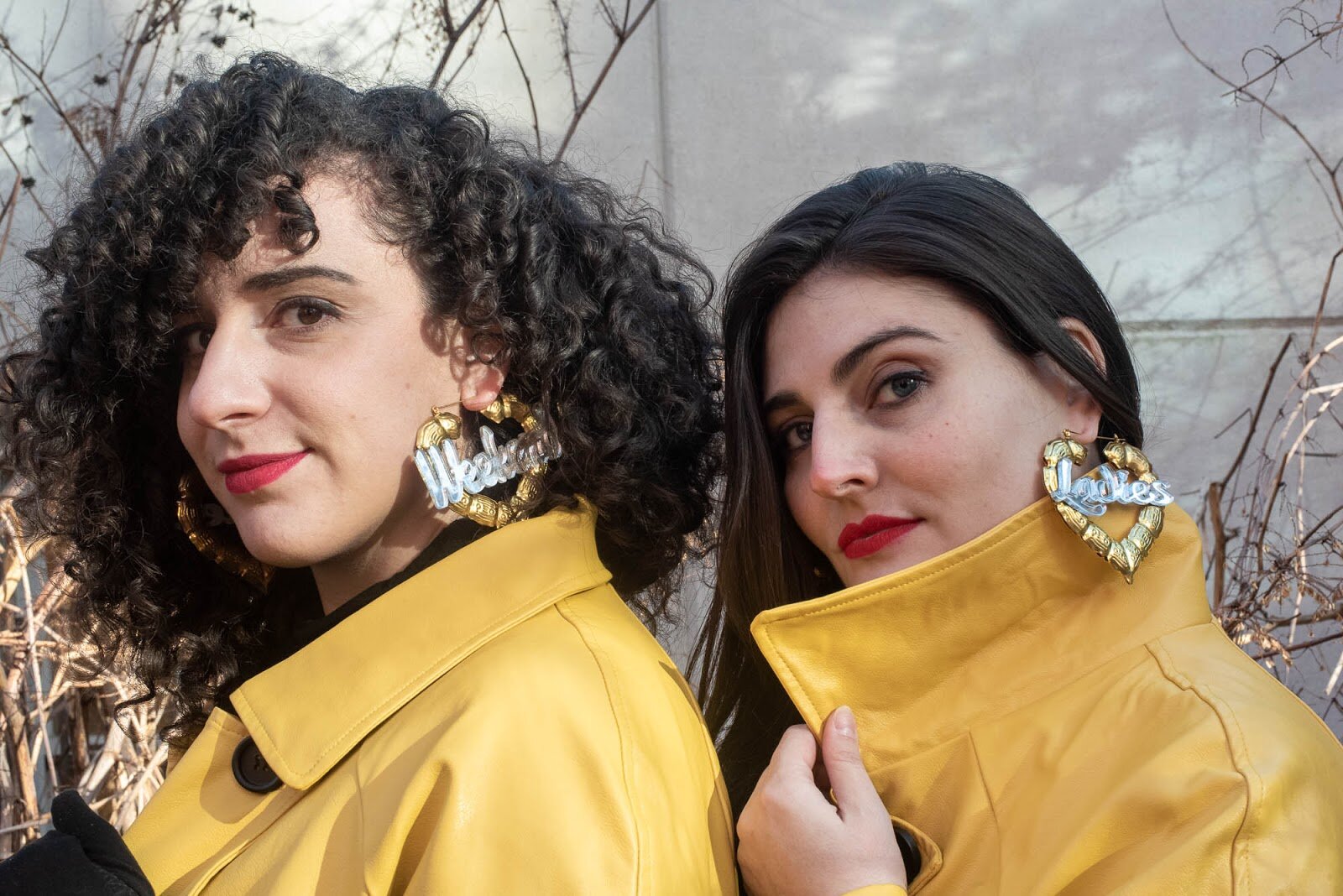
The Weekend Ladies
The Photo Ladies Interview - by Edwina Hay
The Weekend Ladies is the new musical project by Tessa Greenberg and Ariel Sims. Their previous group together, Tayisha Busay, disbanded in 2012 with their final performance occurring at Glasslands Gallery in Williamsburg, Brooklyn only for that venue to close their doors in 2015 due to a new, more profitable, tenant desiring that same location for their new office. Their upcoming EP, Ghost Town, began to form in 2016, a year that marked personal trauma, loss, and the election of Donald J. Trump as president of the United States. Nearly five years later, we’re in a pandemic and most places in New York City are closed because of the deadly Coronavirus a.k.a. COVID-19.
The Weekend Ladies’ newest single “Love is a Choice” can be purchased on Bandcamp and their full Ghost Town EP is now available on all platforms. In this interview, The Photo Ladies help you get to know The Weekend Ladies.
Instagram, Twitter, Facebook, Bandcamp, YouTube, Soundcloud, Spotify, iTunes/Apple Music
Tessa and Ariel, how did you two first meet and decide to make music together?
We met in 2003 at Marymount Manhattan College while studying theater, but we first got to know each other while taking a radical liberal arts class about the social taboos around menstruation. That class ended up informing so much of our shared feminist views that we still incorporate into our art and activism to this day. However, ultimately the music and collaboration were born out of dissatisfaction with what our theater education had shown us in terms of performance outlets. We were both theatre misfits and began looking for alternative ways to engage in the performing arts. I think we both identified in one another that feeling of "Ohhhh, YOU'RE a cool weirdo TOO!" During this time, Tessa had a video assignment for a film class - a song and music video about her favorite sneakers - and asked Ariel to collaborate. It was fun, weird, and it gave both of us some of that outlet we had been looking for that made us think: “hey, we don't have to audition for anything ever again, we can just make our own music and performance art.” We bonded over our shared childhood of singing and taking dance classes during the Jock Jams/90s house & freestyle music era that became a sort of holy grail for us and continues to inform our taste and musical style. After college, we kept making our own weird songs and performances and within a year, we had a handful of bizarre electronic songs written using a free version of Apple's GarageBand that we started performing in the back of bars at odd weekday time slots. At first, our act was more of an early 2000's digital love letter to vaudeville and it didn't fit into any genre but we just kept doing it and enjoying it more and more. Then one day, we sort of looked at each other and said, "Could this be a real thing? Should we maybe try and be….like...an actual band?" The answer was yes.

Ariel during Tayisha Busay’s set at Public Assembly on June 24, 2010.
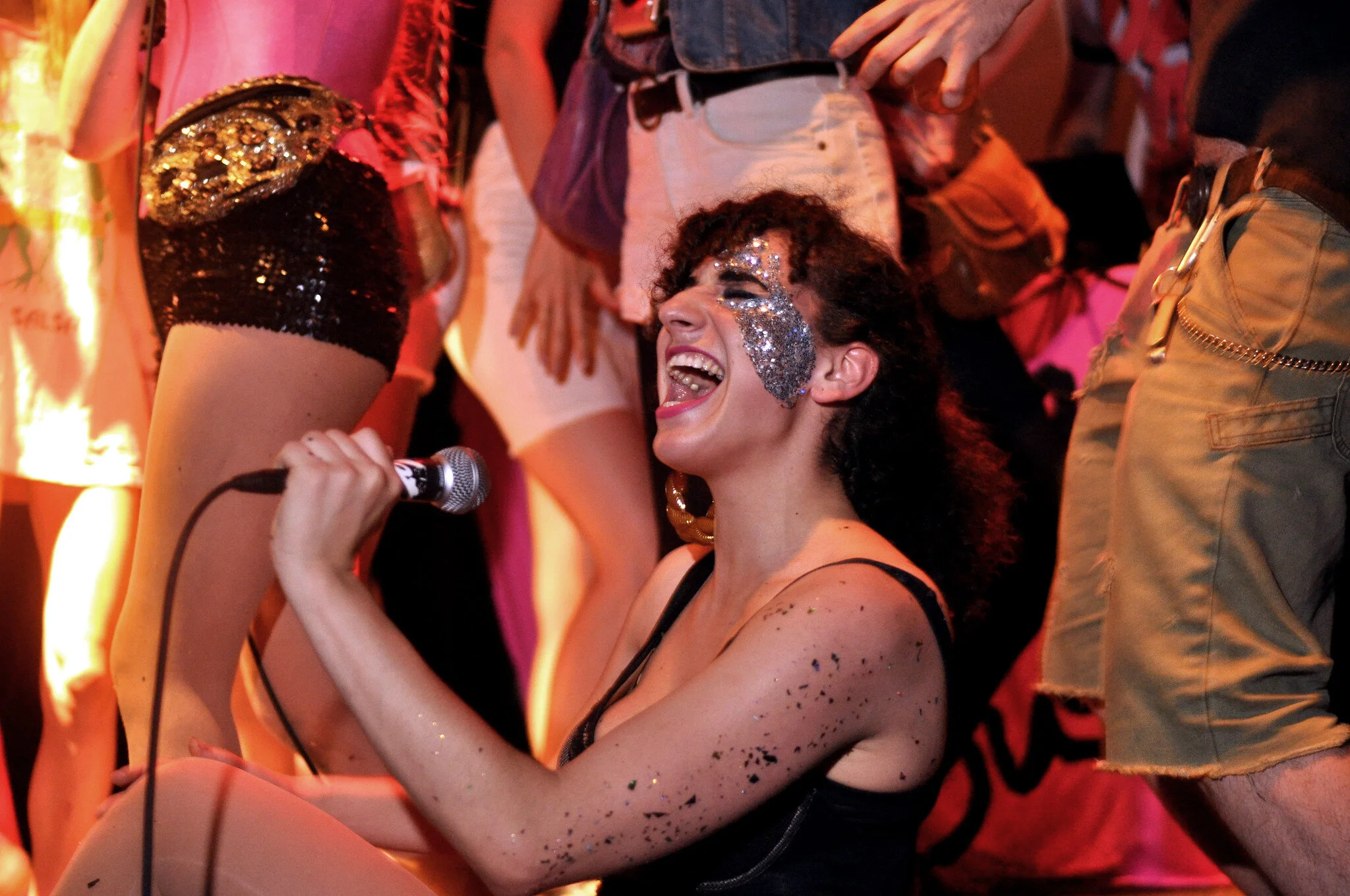
Tessa during Tayisha Busay’s set at Public Assembly on June 24, 2010.
I met the two of you via your previous group, Tayisha Busay, and first saw you perform before Big Freedia at Public Assembly during the Northside Festival in 2010. Can you tell us the importance of New York City in the formation of your music as Tayisha Busay and how that led to your new duo known as The Weekend Ladies?
As Tayisha Busay, we first existed on the furthest fringes of an already fringe scene. We weren't an indie rock or folk band so it was hard to get on those bills, and we weren't a hip hop or DJ act either. At first we really just squeezed our way into every possible show that needed a spot filled... I mean we FINAGLED! We mostly played in Brooklyn and the Lower East Side of Manhattan where there was a lot going on musically. Still perpetually outsider-weirdos, we weren't chic, slick or cool, and we often felt incredibly bored at the popular shows where the bands took themselves too seriously. As young artists, we battled an immense amount of sexism, misogyny, and exclusion, even after the addition of our third member, Brandon Levesque. We rejected the idea that we had to be a sexy women-led band and instead we leaned into our sense of humor and corny Bat Mitzvah-Slumber-Party level stage antics from our Jock-Jams-School-Play-Theater days. We knew that it was our New York too and that we could define it for ourselves. After a couple of years of playing out, we finally crossed paths with some fellow, like-minded DIY electro-pop acts like Planet Rump, Suspicious Package, and Great Tiger. By 2010, indie-electro and DIY dance-pop was more of a "thing" and it felt like New York was finally embracing it (and us) a little bit. Most of the love we got was in the gay bars and alongside other queer acts - like Big Freedia. To this day, it’s the queer spaces that feel like an artistic home to us, anywhere we go. After our last show as Tayisha Busay in 2012, we took five years off from performing together so we could spend time on other jobs and projects, and probably to grow up a little! In 2016, we reconnected after some intense life changes and a period that Ariel would coin as "Raft Times." Our old version of New York had completely changed, but some of the loss we experienced encouraged us to start writing again: that's when The Weekend Ladies formed. After Tayisha Busay, we've joked that we were "traumatized by DIY" and all the scrappiness and hustling that burnt us out in the Brooklyn scene. The Weekend Ladies is a rejection of that. It's now more about the art, leisure, and slow, deep, empowered catharsis that we can create through music and performance. We also learned how this approach to art makes us better activists and all-around more balanced people.
What were some of your favorite venues to perform around NYC that have since closed forever?
Too many, gone too soon! Glasslands was our favorite, even though they'd get mad at us for throwing confetti and silly string everywhere. The old Silent Barn was a hot, fun mess. Death By Audio smelled like shit and they didn't always get us but we still fucked it up a few times. Sugarland really embraced us with open arms and made us feel at home. Shea Stadium was great. The OLD House Of Yes on Maujer Street (but check them out at their current home at 2 Wyckoff Avenue or on the Internet)! The old Secret Project Robot on Kent Avenue. Santos Party House! RIP :(

How would you characterize the Weekend Ladies sound? What are some of your musical influences?
At its core, our music is electropop. As performing artists, we combine our social activism, clowning, and witchcraft to serve fun and emotionally charged anthems for dystopian times. Our musical pizza pie is topped with everything from lots of Robyn, to Devo, Italo Disco, late 80s freestyle like Debbie Deb, Crystal Waters, Cher, Kate Bush, and the sound of our Moms yelling at a customer service person on the phone so they can get $8 back on their long-distance phone bill in 1994.
What is the songwriting process like for the two of you? Do you write lyrics and music separately or together? Has this process changed over the years from Tayisha Busay compared to now?
These days it's very Postal Service-style. One of us will completely produce the music and write lyrics to a near-full song and then the other will take the track and fill in the little details like vocal harmonies or synth fills. We are now very good at letting each other take the lead on a song so it can be its full self, and then giving each other feedback or ideas to build upon what's already there. Writing more individually has also been a great way to avoid forcing the creative process in a room together on an arbitrarily designated day, which is how we used to do more collaborative writing in Tayisha Busay. It was fine but our songs back then were more forced and lacking in depth because we felt we "needed" 1 more ballad or 1 more banger to round out the album or a set. But that was a made-up, bullshit mentality based on what other people had done rather than what made sense for us as artists. Since then, the actual content of our writing has matured and evolved quite a bit based on our personal life experiences from which we write. Tayisha Busay was like a teenager's diary. The Weekend Ladies is a thick, leather-bound, grown-ass journal.

Your first single as Weekend Ladies is “Love is a Choice” and the video features an 80s vibe and displays your sense of humor. How did you come up with the concept of the music video and bring it to life?
We shot the video this summer (still in the throes of COVID-19 restrictions) while we were cat-sitting for friends in Scarsdale, NY. We knew we wanted to do some kind of video for this song, despite the obstacles that the pandemic presented, and this house gave us the quarantined space we didn’t have in the city. For inspiration, we watched a lot of lo-fi, campy Italo videos from the ’80s and ’90s and realized how much we already love and embody this moment in culture and music. Around the same time, we had gotten really into watching all the old “Weird Al” Yankovic videos, almost as therapy for the stressful and heartbreaking time we were living through - we are perpetually soothed by “Weird Al”’s earnest absurdity and his relentless commitment to the “bit.” The plan for the shoot was originally very barebones: we would get a bunch of funny props at the dollar store, have our genius filmmaker friend Suzi Sadler come to the house in Scarsdale for a couple of days with basic equipment, and we would get some fun, very DIY green screen footage. By some stroke of magic that seems to follow The Weekend Ladies around, a porch-side conversation with a neighbor led to the discovery that she was sitting on a garage full of professional film equipment left by her husband who she had recently separated from. A filmmaker herself (and a woman experiencing recent heartbreak as well), she understood what we were trying to do and she lent us the top-of-the-line gear that took our rinky-dink operation to glossy levels that otherwise would have been impossible to achieve. The results are so perfectly us: through a series of random coincidences, we were able to beg and borrow our way into a video that we couldn’t afford, and we STILL chose to film ourselves goofing off, putting press-on nails on our toes and wigs on bouncy balls.
Proceeds from the sales of “Love is a Choice” will go to The Audre Lorde Project. Can you tell us more about this organization and why you chose them as a charity partner for your single?
Our artistic journey of the last couple of decades has been heavily influenced by our activism and intersectional feminism. We have seen that art and music are powerful tools for community organizing and social justice. Over time, the majority of our shows have become fund and awareness-raising events for various causes. Both of us have a healthy obsession with the poet/activist/feminist Audre Lorde, and also with the organization that evokes her name: The Audre Lorde Project, based here in our adopted hometown, Brooklyn. ALP is an LGBTSTGNC organization focusing on people of color in the New York City area. This org is about as intersectional as you can get, tackling the issues that arise as a result of compounded oppression of folx experiencing concurrent forms of discrimination based on gender identity, sexual orientation, race, immigration status, wealth inequality, etc. We also love ALP’s hyperlocal approach, letting them focus on the nuanced struggles that New York City presents.

What was the recording process like for the songs on the Ghost Town EP?
Our approach to writing and recording has always been very DIY and most of the production is done solo, bedroom-style. With this release, we wanted to achieve very clean, pop-sounding vocals, which is very hard to do when you don’t have the right equipment or space. We teamed up with our friend, engineer Thomas Ricard, who had done some previous work with Ariel for her solo project Ariel & The Swoon. He had the right equipment, knew what he was doing, and was a great energy match for us. It was important to have someone at that stage with a new perspective come into the mix after the two of us had been in a feedback loop with these songs for so long. Thomas recorded all of our vocals at his space at the infamous Danbro Studios in East Williamsburg, helped us with some of the arrangements and effects, and he played a sick guitar part on “The Gun.” Miraculously, we finished the recording of these tracks just weeks before COVID would close down the city. Our very talented friend Joseph Colmenero mixed and mastered Ghost Town. Tessa has worked with Joe on some of her previous solo releases under the name TWERP and he was willing to help give these songs the bump that we needed!
What is your definition of a Weekend Lady and how do you become one?
At some point, our shitty capitalist society invented this stupid idea that weekdays were for work and weekends were for fun and leisure. Fuck that. And fuck anything trying to exist solely in the binary! We have day jobs too - but experiencing joy and feeling blissfully untethered is something that anyone should be able to embrace during any day of the week, month, or year -- and as any gender. We happen to be cis-gendered ladies but, the truth is, ANYONE can be a Weekend Lady/Person/Spirit and the secret is that you already ARE one! Maybe your weekend spirit means smashing a bunch of burnt-out lightbulbs in the street just to hear that beautiful sound. Or maybe it's just sleeping in and eating two bags of the recently re-released 3D Doritos because the texture has a very special mouth feel. A Weekend Lady/Spirit embraces an instinctual will to find that joyful Saturday energy for even ONE minute on even the darkest of days. It's a fucked up world, but no one and nothing should be allowed to steal the joy and love you have within -- not even an asshole on a Monday.
Also, there used to be an amazing discount store on Knickerbocker Avenue in Bushwick called “Weekend for Ladies” where we used to frequent for the $1 rack!
If New York City resumes live events within the upcoming year, what do you envision being next for The Weekend Ladies?
It’s fair to say that about 50% of this project relies heavily on the performance aspects and it has been almost unbearable not having live shows to complete the true birth of Ghost Town. In the meantime, we have been able to focus on making some really great music videos and overall are trying to use this strange opportunity to delve inwards and out of our comfort zones. We hope to partner with new friends for some streaming/experimental/virtual experiences soon - if you host anything like this, hit us up!
3/4ths of the song titles of the Ghost Town EP are “Feel Like Shit,” Tired,” and “The Gun.” My final question for you is, are the Weekend Ladies okay now? I mean, besides the global pandemic and the general collapse of our society, of course.
In truth, the last four years have been incredibly rough on both of us - personally, professionally, politically, etc. The desperation, despair, and heartache was relentless and at times, insurmountable. However, making art about strife is very therapeutic for us. Written years before any inclining of the multiple global catastrophes we are currently experiencing, the themes of these songs are eerily relevant. When listening to Ghost Town now, we also can hear the beautiful things that we have learned about ourselves, each other, and life. We hear the trials and tribulations of an emotional odyssey that prepared us to weather this storm: Ghost Town is our unexpected adventure of hauntings and hallucinations that finds light in the dark and strength in sisterhood.


INTERVIEW: Elise Eriksen

Elise Eriksen
The Photo Ladies Interview - by Emily May
At just 17 years old, emerging pop star Elise Eriksen is already creating a buzz with her fun and fresh pop sound. Having discovered a love for music at a young age, she spent years playing the piano, honing her songwriting capabilities and refining her vocal skills. Her varied musical inspirations range from Stevie Nicks, Alicia Keys, and Don Toliver, leading the young artist to emerge with her own spin on fun and feel-good pop. Born in Norway, she moved to New York City as a young child and is currently based in Los Angeles. As the daughter of GRAMMY-winning producer Mikkel Eriksen, one-half of renowned producers Stargate (Rihanna/Katy Perry/Coldplay/Jay Z), Elise had the distinct advantage of growing up around a wide array of the world's top artists and songwriters. As a result, she was instilled with the hard work and dedication she would need to succeed in her own career. In December of last year, Elise released her debut single "Less", co-written by Julia Michaels and featuring guest vocals by Shoffy and Blu DeTiger on bass. The song is about growing apart in a relationship, and with its shimmering textures and bass-heavy grooves, “Less” finds Elise and Shoffy trading off verses as they reflect on the increasing distance between two partners, creating a track with a mix of bittersweet lyrics and an upbeat tempo. After overhearing her father working on an early version of the track, Elise felt immediately grabbed by the melody and was determined to rework the song. With Julia Michaels’ blessing, she then reimagined “Less” according to her own distinct vision, and quickly caught the attention of Shoffy and Blu DeTiger.
“The first time I heard ‘Less’ I was really struck by how the chords were sort of jazzy because I have such a huge appreciation for jazz,” says Elise, who names Ella Fitzgerald and Etta James among her all-time favorite singers. “It’s such a perfectly crafted song, and I love how there’s this new meaning to it now everyday life has been so drastically altered. I think everyone can relate to feeling isolated, and just wanting to connect and be together again.” Today sees the release of Eriksen's second single "Smile", which was co-written by Sasha Sloan (Charli XCX, Camila Cabello, Anne-Marie, Katy Perry) and shows a different side to Elise who also plays piano on the track and speaks to putting on a façade and smiling even though you’re not okay. “Smile" is about putting on a façade and trying to seem happy even when you’re not,” says Elise on the inspiration behind the song. “As a teenager, I really connected with the idea of feeling like you can’t always be completely yourself, which I think is something that a lot of people experience. I want to speak about things that are meaningful. It felt important to put out something that will leave people feeling more in touch with themselves but also more hopeful and uplifted, especially because it has been such a tough year.” With plans to release more music, music videos and engage in collaborations with other artists and different genres, I think it's safe to say that Elise Eriksen has a bright future ahead of her and is definitely an artist to watch! You can connect with Elise Eriksen via the following links. Photo credit: Mikkel Eriksen.
TikTok | Facebook | Instagram | Twitter | Spotify | SoundCloud | iTunes/Apple Music | YouTube | Deezer
You are originally from Norway and moved to NYC soon after discovering your love for singing. What can you tell me about growing up in Norway and discovering that love?
I'm extremely thankful that I got to grow up in Norway. It was great because you're surrounded by down to earth people here who don't care where you're from or who you are or what you've done. They just care if you're a genuinely good person. Norwegians are also a lot of fun… I mean, we're Vikings, so what do you expect? My childhood was fantastic and I travel back every summer. It’s the best and the people here are great. There's hardly any focus on the superficial, which I really appreciate.
My dad has always been a part of the music. My grandmother, too. She was really huge in the theatre world and performed all over France and in different places in Europe. She also sang in bands and was incredible. I think that, because of her, my dad was so exposed to music and I’ve been lucky enough to experience it through him.
What was it like for you to move from Norway to NYC? What were your first impressions of the city and how did living in NYC influence and shape you as an artist?
It was a culture shock. I was just a kid, but I remember starting school there. I had to do my ERB's and try to speak English when I did not know what I was talking about at all. New York is probably my favorite place in the whole United States. It's filled with such diversity and there are just so many different types of people who come from all different backgrounds, and who have an interest in all different types of things. So many people go there to do something great and that's what makes it so interesting because you're just surrounded by talent. It really humbles you. When there are so many people who are good at things, then you ultimately have to work 10 times harder. LA is similar, too. It’s more laid back, but the whole vibe of LA is just a melting pot as well. You have so many people in the creative industry around you that, for the most part, want to help you and want to do great things as well. You meet so many people that can assist you in your journey… And there’s better weather.
What can you tell me about your decision to move to LA and how the scene in LA compares to that of NYC? What do you love and find inspiring about living in LA?
It wasn’t really my decision to move away as I was in fifth grade and don't know how much I really could have done, but we wanted to kind of change things up because we had lived in New York for such a long time and the creative industry was really blossoming in LA. In LA, I think, you really get inspired because of all the creative people that are there. If I hear someone say something interesting, like a little phrase or a couple of words, I'll write it down and maybe use it in a song. There's so much in your daily life that you can take inspiration from, or take little phrases from, that you can use in your music. I've also gotten a lot of help from teachers to really perfect my craft, and to learn how to perform and to sing live. I would say it's a really creative place to be. I really, I really enjoy living in LA.
Your father is Mikkel Eriksen, GRAMMY-winning producer and one half of uber-producers Stargate. What was it like for you to grow up in the studio, surrounded by the world's top artists and songwriters? How has having a father in the industry, as well as the exposure to so much talent growing up, helped you to navigate the music industry in the pursuit of your own music career?
Growing up with him in the studio and around all those people was inspiring to say the least. It was incredibly humbling as well because you see these people in a whole new light. You see them when they're not wearing makeup and they’re in their sweatpants at, like, two in the morning working their ass off just to make something cool. It really shows you that they’re real people who do put in the hours and the effort to be something great. It shows you how they really earned what they did. Growing up with my dad taught me that it isn't just the fun things, like release parties, or the GRAMMYs and award shows, or TV for that matter. It is those long nights and those drafts and the 100,000 takes. That’s what you’ve got to do to really be one of the greatest and that’s something that I’ve learned.
I’ve also learned that you have to accept help too because nobody does it by themselves and dictates everything. It’s always a group effort. The most successful people take inspiration and then take advice. That’s what makes these things great.
What is the best advice you have received over the years?
Collaborating is one of the most important things in music. Sitting there and starting from scratch with nothing other than a piano and a piece of paper and isn’t how it really works. I mean, sometimes you can do that if you’re lucky, but I think that accepting help and knowing that other people can contribute as well is really important advice. You realize that there are so many moving parts to this industry and all of those parts contribute to your journey. So, I would definitely say to start by reaching out to people and seeing if they want to make something. You don’t even have to use what you create but reaching out to people and working your butt off are the two most important things for sure.
What can you tell me about your recent single "Less", co-written by multi-platinum songwriter Julia Michaels? What inspired your decision to re-work the song as your own and what was that process like?
“Less” is a funky and upbeat song that can speak to a lot of people through his message, I think. I wanted the song to reflect who I am as a person, even though I haven't had a crazy amount of relationship drama myself. I want to really be able to stand for what I’m singing, so that’s why I used the production I used and interpreted the song in a different way. The production is a mix of all the genres that I really love and the elements that I find really cool about those genres. I just wanted to make this on my own by changing up from the original composition so that it really did become something of my own and something that I'm proud of.
What was the inspiration behind the music video for "Less" and what was it like to work with Shoffy and Blu DeTiger? It looks like it was a fun video to make!
Working with Shoffy and Blu was amazing. Shoffy is super, super nice and Blu is awesome and inspired me to start learning bass.
I wanted the video to feel genuine, so we shot it in locations that I've grown up around with the people that I've grown up around. It is a really personal video to me because it is in my hometown and has my closest friends in it. I wanted it to be fun and uplifting. It’s just a happy, quirky video with a bunch of colors and liveliness, different outfits that contrast with settings, and all things that I find really fun because I wanted the video to show my personality.
At just 17 years old, what has it been like to have a career in music at such a young age? Do you feel as though juggling schoolwork with writing and recording music presents a challenge? What do you like to do for fun when you aren't working on your music?
I've wanted to be a part of the music industry so long and I really worked on myself and my craft. I’m still growing but, for right now, this felt like the right time. It has truly been a fun journey, but juggling everything has been weird. Half of me focuses on the music side but then I also have statistics homework to do the same day, which is kind of weird. It hasn't been awful because music doesn't feel like a chore at all. It feels like something that is a hobby for me, but with the pandemic I've had a lot more flexibility in my schedule. I've been able to focus more on the music side. I've had the opportunity to really, really work on everything because I dropped all the social stuff.
When I’m able to, I ride horses and I'm really interested in fashion. I love taking pictures, spending time around animals, going on walks, being outside, and swimming – just not in the ocean, I’m not a fan. I do love spending time with my friends and doing things with them, but it has been very limited.
You have said that over the years, you have learned what it takes to create the perfect pop song. What have you learned? What does a good pop song look like to you?
I think I've learned that pop can be a lot of different things. A common association with pop is that it needs to be middle of the road or vanilla for it to be successful, but pop can really be something really interesting if you merge it with a lot of other things and a lot of other genres. I’ve also learned that, although they may sound simple or easy to sing, it's not as easy as it looks. I've done covers of other songs my whole life, but once it really becomes your own you want to present your best work. You want to present something you're proud of. I've learned that it does take time to really make something your own.
I would say a good pop song just tells a story. If it tells a story that people can relate to, or that people can understand, and it’s conveyed in an interesting and descriptive way, I think that that really makes a pop song good. If it becomes personal, then people can connect to it and if it's happened to you then a lot of the time it's something that other people have experienced as well.
What can you tell me about finding your sound as an artist?
I think that we're constantly on the hunt to find our sound. I think that's a never-ending process, almost. Particularly for me, there are so many different things that I'm interested in trying out and that I want to do. My voice is my sound somewhat, but I'm really open to trying other things and seeing what works best for me. I want to be able to have variety in what I do.
Having honed your songwriting craft over the years, what was your process like when you first started writing songs and how has it evolved over the years?
When I first started writing songs, they were just poems. A song is kind of a poem, really, but it was mostly just phrases and random words that I wasn't able to complete. Over time, I've gotten significantly better at being clear in my storytelling and using real life experiences to tell stories. Storytelling is one of the hardest but also most important things to do in music. So, I think that writing songs started out as being really difficult, but you have to write 100 crappy songs to get one okay one and then 100 more to get one good one.
Who are you listening to right now? Who are some of your favorite artists? Are there any new artists you've discovered that you feel like people should know about?
Right now, I’m really loving 21 Savage’s new album with Metro. I love, love, love that one… And I'm always listening to Pink Floyd and Fleetwood Mac, those are two of my favorite bands. A new artist that I actually thought was really cool is a band called Hotel Ugly. One of their songs has 2 million streams and I think it is so good. I really want people to hear them because I think they have something really cool. I’ve become a new fan.
What's next for you?
I just released a new single called “Smile”! I’m also working on a body of work and we're filming interesting videos, which is super exciting. I think I'm just going to keep working at what I do, collaborating with more people, and seeing what's out there and experimenting with genres!

INTERVIEW: Elder Island

Elder Island
The Photo Ladies Interview - by Emily May
Electronic-pop trio Elder Island traverses the sounds of many genres. Based in Bristol, they blend electronica, indie, pop, and neo-soul to weave together a sound that threads together poetic lyrics, unique instrumentation, and synth-heavy dance beats. The trio met six years ago in Bristol while attending university to study fine arts, photography, and graphic design, with the city's diverse music scene providing the inspiration and opportunity to play music together. Although the trio started out doing casual jam sessions at home, things took off for them when their 2014 self-titled debut EP gathered steam amongst the public, allowing the band to focus more seriously on their musical endeavor. Their follow up EP, Seeds In Sand, saw the band finding and becoming more comfortable in their sound. Where their debut EP had been an ambient soundscape of field recordings, loops, and percussive elements, the follow-up was a more cohesive collection of five dance-influenced tracks. Their songwriting process adds to the magic of their sound, with each song starting out as a jam session in which various ideas and instrumentation are mixed together to create a song. 2019 saw the release of their album The Omnitone Collection, described as ten tracks that are rich tapestries of tiny moments in time, but also sweeping soundtracks weaved with ambition. The band created bespoke artwork to accompany the album, describing The Omnitone Collection as an “integrated concept”. This form of commitment is evidence of the hands-on, DIY approach the band undertakes in many aspects of their music. 2019 saw Elder Island take The Omnitone Tour to Europe and North America twice, with over 60 dates. This included sold-out shows in New York’s Bowery Ballroom, El Rey Theatre in LA, and an electric, sold-out performance at London Roundhouse. Capturing their dates on their Omnitone Tour, the band released a short documentary last year that not only documented the unique, immersive quality of the band’s live performances – which have inspired sell-out shows at iconic venues around the globe – but it also heralded a raft of new tour dates for 2021. A remix of the album was released last Spring, featuring remixes by fellow musicians and admired artists such as Shigeto, Matthew Dear, and Dirty Nice. The band recently released their latest single and accompanying video for "Feral". A dramatic track, it builds towards a crescendo with inexorable, synth-lead force. “It's got a driving aggressive sound that's quite dark, and then this light bossa nova beat that goes along with it,” explains bassist Luke Thornton. “The song is inspired by childhood memories of fear, so the track has become a juxtaposition between darkness and light.” In a nod to the classic double-sided cassette and vinyl singles, Elder Island also release B-side “Absolute.” Juxtaposing the intensity of the A-side, “Absolute” is the antidote to “Feral,” a drifting synth-led track floating melodically through soft, choral vocals, which nevertheless maintains an unrelenting 4/4 beat. Reminiscent of a short film, the music video for "Feral" embraces the paranormal and the sinister discomfort of vast, desolate landscapes. Directed by Jordan Martin who has worked with the likes of Fontaines DC, IDLES, Heavy Lungs, Two Door Cinema Club, and Bastille, the video centers around a flickering fireside and the band as cult-esque figures, barefoot and shrouded in the dark. Filmed on the outskirts of Bristol, it moves between haunted outhouses, vacant grounds, and Hitchcock-styled chiaroscuro driving scenes with a permeating sense of dread, visually exploring the burden of childhood nightmares. With a new album in the works, Elder Island is definitely a band to follow into the new year! Elder Island is vocalist and cellist Katy Sargent, bassist and beat maestro Luke Thornton, and guitarist and synth master David Havard. You can connect with Elder Island via the following links.
Website | Facebook | Instagram | Twitter | Spotify | SoundCloud | iTunes/Apple Music | YouTube | Bandcamp
Luke and David- You knew each other growing up and met Katy while attending university, recruiting her to play with you when you heard her playing the cello. Early on you preferred folk tunes over the synth sounds you now play. What can you tell me about those early days of playing together and the evolution of your sound?
David - When we started playing together, we only had a few instruments at hand. It started with an acoustic guitar, acoustic bass, a cello, and a very basic drum kit. We had a 2-channel interface, one microphone, garage band and would experiment, teaching ourselves how to record, trying different things out. It wasn’t long before we got a copy of Ableton which really helped open things up. We were still mainly using acoustic instruments but were learning to manipulate them and loop in time together to start creating beats. In the years leading up to us making our S/T Ep we had managed to accumulate quite a few more instruments and effects from bargain eBay purchases and making DIY equipment. We would play together when we found the time in between work and it was these early sessions that would be the foundation for that EP. When we made that record, we intentionally played everything, recording directly into the arrangement. We didn’t want to use Ableton for the instruments, just to record and produce the record. I picked up a Pianet T, which was quite a crucial instrument for me as it’s when we started to use keys, not just stringed instruments. I found an old Yamaha PSR-21 keyboard, which was hidden in a cupboard at home, which was the only synth on the record, as it was all we had, but ultimately added to the lo-fi nature of the recordings. After putting that record out and seeing its response, we started to take things a little more seriously. We had a lot to learn, trying to translate that record into something that worked in a live environment. I think every show we performed for a couple of years had a technical issue of some kind, but it’s where we refined our instrument choices and found the basis for how we perform today.
Your process for writing music tends to involve marathon jam sessions. What do you find inspiring about these sessions? Are all of your songs a result of these sessions or do you ever find yourself with specific song ideas going into them?
Luke - I believe the inspiring aspect is getting lost in the moment. Most of the time when this happens, something unique ends up being created. There is nothing more special than that.
You started out writing, recording, and producing on your own in your basement studio in Bristol, but with your first LP, The Omnitone Collection, you worked with Ali Chant at his studio, Play Pen. What can you tell me about the process of doing everything yourself vs working with another producer and what led you to reach out to him? You have said that the album had more of a songwriting focus and that working with Ali led the songs to be more sculpted. What can you tell me about the process of making that album?
Katy - Producing at home is a double-edged sword. You have all the time you need to realize tracks and get them right but there is a tendency to agonize over decisions and things can take a lot longer. It's always hard to know when to stop. When working in a studio you have to be more prepared and because ‘time is money’ you have to make quicker decisions. There is also someone present who can guide and offer a second opinion. Alternatively, these aspects can cause you to rush and the additional person sometimes means another link in the chain of production, having to explain your vision before you can enact it. I think with the Omnitone album we had got the tracks to a good point in our own studio but were struggling to finalize/ finish them. Ali really gets our long processes but as an external producer has the power to chivvy us along a bit and say is this your final decision? It's what we needed.
What can you tell me about your love of old school equipment vs digital gear and your aim to mirror the level of care that goes into the production of old artifacts in everything you create?
Luke - The biggest pro of doing things digitally is that the process is always faster. It's incredible what can be achieved now with digital equipment and the development is never slowing down. The good thing about old school equipment is that it was built to last and if treated with care can last forever. Our goal is to use whatever gear old or new as tools, then see if it inspires us to create something with it. So far it has yet to fail us.
You recently released your new single "Feral" and the accompanying music video. What can you tell me about the inspiration behind the song and the idea behind the video, which brings to life the uncomfortable dread of childhood nightmares and the anxiety and fear of what awaits you when you finally fall asleep? Was the song based on real-life experiences?
Katy - Sonically there’s a contrast in the track between the lightness of the Bossanova / mambo beat and the darker ominous driving bass. A sense of foreboding with a naive twist. Lyrically I was exploring a time in my childhood when I was testing the boundaries of what was right and wrong. A fear of things you don't understand but also the exhilaration in this fear. I reference films that I had watched at friends' houses whose parents did a little less censoring than mine. Late Night horror movies, Candyman, and satellite’s delight ‘Are You Afraid of the Dark’ (a North American kids horror television series). Watching these things elicited not only a fear of what I had visually seen but also a deeper feeling that I’d watched something forbidden. These feelings as a child are way more prominent than those of an adult. Everything is interwoven into your imagination and thus your everyday. I didn't sleep much as a child but I certainly didn't sleep much at these horror house sleepovers. I could dedicate some of the sleepless aspects of the video to these long nights awake believing there was something ominous drawing closer.
The video is described as a spooky cinematic seance. What led you to shoot the video like a short film and what was the filming process like?
Katy - The short film probably comes from us trying to squish as much into the video as possible without bursting its seams! We ended up with way more footage than was needed and it was a definite ‘Kill your Darlings’ scrapping certain sections, but the video benefit as a whole from these decisions.
What can you tell me about the different locations in which the video was filmed?
Katy - We filmed in two main locations with a few extras for B-roll. We were looking for classic eerie settings. Dusty cobwebbed barns and creaking outhouses. As per we called in a few favors. One sight was with some incredible friends of ours who live on the outskirts of Bristol. It’s a semi-rural, slightly wild, and sprawling place that I love. The other was near Gloucester where Director Jordan Martin's grandparents live. A fitting location being a place he had spent a lot of his childhood. They were also the owners of the small well that we hung Luke over and the fantastic Saab 900 convertible that I got to drive.
You have said that the video pays homage to the horror films that broke your childhood. What were those films?
Katy - It's a great talking point as everyone has one or two shows they saw as a kid that stayed with them! I think mine was watching MJ’s Thriller Video for the first time and then also watching Candyman way too young. Really shook me up. I also asked Luke and he said Chucky. Dave coincidentally mentioned episodes of Are You Afraid of the Dark but then started talking about a scene in a film he had seen with walls closing-in and spiders pouring out. No idea what the film was but it seems to have had a lasting impression.
With an upcoming album in the works, what can you tell me about the process of recording your second LP compared to your first? What can listeners expect sonically? What else can fans look forward to in the coming months?
Luke - It has been a shakeup to how we've written previously. For the first album, we had songs that were created around the same time as “Seeds In Sand” that were being finished and incorporated into the album. With this album, we started from scratch a few days after our London Printworks show. The lockdown happened, so we put our heads down and pretty much spent the entire year making the music and discovering new instruments and equipment. Without giving too much away, expect to hear a sonic landscape filled with the new instrumental discoveries we’ve made. It is an album reflective of the year it was created whilst having an anomalous charm. We’ve had to move live dates on so that our first shows will be the UK and IE tour in May & June. Fingers crossed. We are however hoping to record some live performances to put out in the interim. Looking forward to the challenge of transforming the new tracks into a live show.

INTERVIEW: Good Bison

Good Bison
The Photo Ladies Interview - by Emily May
Alternative artist Pablo Alvarez has found his voice as an artist after years of experimenting with multiple genres. Born in Bogota, Colombia, he and his mother emigrated to the culturally diverse city of Miami, FL when he was a young child. Alvarez discovered hip hop, Star Wars, and skateboarding, cultivating his internal creative self and later earning a spot in The Guinness Book Of World Records for the Longest Consecutive Rap, freestyling for 26 hours straight in a live broadcast. As a young adult, he moved out West to Los Angeles in an effort to start a music career and formed his latest musical project Good Bison. It was in Los Angeles that Alvarez feels as though he truly found his voice as an artist. Combining elements of surf rock, pop-punk, indie rock, and hip hop, his music is creative and unique without sounding chaotic. Good Bison has released 2 EPs in recent years, 2016's debut EP Buffalo Roots, which explored indie-rock, lo-fi pop, and electronic sounds, and 2017's hip-hop leaning mixed tape That's Bodhi, influenced by acclaimed producer Jeremy Hawkins, whom Alvarez met shortly after releasing Buffalo Roots. 2019, however, saw Good Bison move back into an indie and rock direction. For Good Bison's latest EP, Scattered Storms, due to be released later this month, he wrote and recorded all the music for the EP with Mauri Viladegutt and Slightly Stoopid producer George Spits. Largely acoustic and rhythmic in sound, the 4 song EP showcases his ability to twist melodies and hooks on a dime and embraces organic instrumentation, such as percussion instrumentation from a kid's toy set and a Colombian rain disk. “I want my music to help people feel less alone in the world, as cheesy as that sounds,” he laughs. “My favorite songs speak to the shared human experience. We may all live wildly different lives, but we go through so many of the same feelings and emotions, and in a way, music helps us understand that we’re all in this together.” In November of 2020, Good Bison released their first single from the EP, "Can't Predict The Weather", a song about loss and learning to be ok with it. Most recently, "Lunatic", the second single from the EP, was released. "Lunatic" is the second song I wrote on guitar and it was inspired by multiple trips out to Joshua Tree in the middle of the night," says Alvarez about the making of the song. "One time, I was walking around the desert at two in the morning and genuinely started to feel like I was lost. Nothing looked familiar, and I had wandered pretty far off the main trail which is super dangerous and not something anyone should do. I was lucky enough to eventually find my way back to the campsite, but that feeling is something I carried with me while working on this track. I'm still not sure if I've made it home yet, but at least I'm not lost in the desert." "The lyrics to me are really about being patient and not letting yourself get overwhelmed with anxiety," he continues. "Even if life isn't exactly how you want it to be right now, there's still plenty of time for things to change. But you also can't be so caught up in getting to the finish line that you miss out on the ride." Combining bits of Beck’s Odelay, Weezer’s Blue Album, The Front Bottoms’ self-titled debut, and the tongue twists of Eminem’s The Marshall Mathers LP, the new EP is ambitious and self-assured, a solid EP from a solid artist. “I credit this morph to a re-found confidence, and the desire to create something that was representative of myself, rather than something that sounded like what is already coming out. I wanted to make something that was true to me.” You can connect with Good Bison via the following links.
Facebook | Instagram | Twitter | Spotify | SoundCloud | iTunes/Apple Music | YouTube
You grew up in Miami after emigrating there from Colombia as a child. What can you tell me about growing up in Miami and learning to integrate and fit into a new culture? You have mentioned that your first real sense of belonging was within the skateboarding community. What can you tell me about discovering skateboarding and finding a sense of belonging within the skateboarding community?
When I moved to the United States, I didn’t speak a word of English, but Miami has such a huge Latin culture that the adjustment was easy for me, especially since I was only seven years old. We landed in the US on July 4, 1999, and my mom told me the fireworks were to celebrate our arrival. I remember I was scared that people wouldn’t be able to understand me, but to my surprise, pretty much everyone spoke Spanish. I like to say I learned English listening to The Marshall Mathers LP on repeat, which isn’t entirely true, but I was obsessed with Eminem from the moment I first heard him rap. I memorized all his lyrics, even before I fully knew what he was saying.
A friend of mine gave me his old skateboard for my eighth birthday, but it took me a few years to really get into it. I didn’t hang out with a lot of people, so skateboarding was great for me because it was something I could do on my own. I’d force myself to go to popular skate spots, and pretty soon I had a crew who I would meet up with literally every single day. We called ourselves Soda Skateboards. We weren’t anywhere near as good as the other skaters in our scene, but using my camcorder we’d shoot ourselves skating and I would edit the videos. I used “The Kids Aren’t Alright” by The Offspring for my first skate part. Skateboarding gave me something to do, and people to do it with.
What has your journey been like of exploring many different styles of music to try to find where you fit in? What have you discovered about yourself as an artist in the process?
I used to fantasize about making music, but never considered the possibility that it would happen. When I started recording, rap felt like my only option, not only because I loved the genre but also because I couldn’t sing, and I couldn’t really play any instruments. But I could write. Lyrics always came naturally to me. My first songs didn’t even have choruses. They were just long verses. Eventually, I started adding hooks and exploring melodies. After high school, I was in a band called Dinosaurs ‘N Disasters, and for a while, I just saw myself as the group’s rapper. But thanks to that experience I developed as a songwriter, and I realized that I could and I wanted to do more than just rap. With Good Bison there was a lot of experimenting to try to find my lane. “Buffalo Roots” had a much more indie-pop feel, and then “That’s Bodhi” once again leaned into my hip hop roots. But releasing that mixtape and breaking the Guinness World Record for longest freestyle pushed me in a completely different direction. I lost my passion for rap. I wasn’t writing lyrics anymore. I was kind of lost. Around this time, I started playing more guitar, and I became a huge fan of ’60s and ‘70’s Rock. When I felt motivated to make my own songs again, I didn’t want to follow current trends or try to fit into any specific genre. I decided that I wanted to follow the music wherever it took me. Like when I was 17, writing songs without choruses, getting out whatever it is I needed to.
What inspired you to move to LA six years ago and what were your first impressions of the city? What do you love and find inspiring about living and making music there and how do you feel that being there has helped you to find your voice as a musician? Having settled in LA to find your own version of the American Dream, what does that look like for you?
In 2014, my band Dinosaurs ‘N Disasters was playing all over South Florida and we were finishing up our second EP. We were in the middle of planning a tour when two of the members decided they wanted to pursue their own careers. That same night, Mauri, Sebas, and I decided we were going to move to Los Angeles. We scrapped the EP, stopped planning the tour, stuffed all our belongings in a car, and drove west. I had never even been to LA. I was immediately blown away by how many different scenes there were in the city. It felt like anything you wanted to do was fair game. I was also able to connect with some incredibly talented people who helped elevate my music even further. I didn’t know what I was going to do when I got here. I didn’t have a place to live, or a job lined up. But I was willing to do whatever it took to make living in LA a reality, and six years later I’m still here.
You have said that when you bond with someone musically, that bond lasts a lifetime. What can you tell me about your friends/bandmates Mauri and Sebas and how you met and began playing music with them? What was it like to move together to LA and what has it been like to have played music together for so many years?
Good Bison is, and always will be, a collaborative project, but it’s not a band in the traditional sense of the word. Mauri, Sebas, and I started this when we moved to LA, but there are so many other musicians who have contributed to the sound. JHawk Productions, Psolomon Williams, George Spits, Sean Magill, Abraham Mendez; just to name a few. I’ve known Mauri and Sebas since I was 13, but our relationships really started to develop when we bonded over music. Mauri was there when I recorded my first song, which led to us writing and performing together. Sebas joined Dinosaurs ‘N Disasters not too long after that. Moving to LA together was an incredible experience, and for years the three of us lived in the same house. But in a lot of ways, leaving Miami felt like one giant step forward and a million tiny steps backward. The only way Good Bison was able to progress was by opening the doors and letting other people get involved. Mauri and Sebas will always be a huge part of Good Bison, but I’d say the lineup is in a perpetual state of flux. For ‘Scattered Storms’, all the music was written and recorded by Mauri, George, and myself. But the last song I released before this EP, “Nowhere To Go”, was made by Abraham, Sebas, and I. I feel incredibly lucky to have so many talented people willing to contribute to the vision.
Aside from music, you are also a writer! How did your interest in writing develop? You have called writing the gateway drug that got you into music, so having written for publications and online websites such as LA Weekly, Miami New Times, and GUFF, what was the transition like for you to writing songs? Do you still write for publications and websites or are you focusing more on music right now?
I’m pretty sure I’ve been writing for as long as I’ve been able to hold a pen. I have countless notebooks filled with stories and poems from when I was a little kid. I don’t even know how it started, I just know I’ve always loved it. I thought I was writing novels when I was 10 years old, but looking back on them now my ‘chapters’ were not much longer than a paragraph. Writing is the only reason I started making music. I figured if I could write stories and poems, I could probably write lyrics too. The big difference was that when it came to music, I wasn’t writing fiction anymore. I was writing about myself. Later I got the opportunity to write for magazines like Miami New Times and LA Weekly, and I focused on covering music as much as I could. I loved interviewing artists and reviewing shows, but nowadays I’d say almost all my writing is for Good Bison.
You have said that it took a while for you to understand that songs were more than what you were putting down on paper. What have you learned about your songs over the years and what they mean to you?
Since writing is such a huge part of who I am, lyrics have always been at the forefront of my understanding of music. Listening to hip hop, I didn’t care about the beats. I was in it for the raps. No matter what genre I was currently into, the only thing I was listening to was the words. I couldn’t pick out guitar riffs or bass lines, or differentiate drum patterns. That started to change when I was in a band, and even more so when I learned to play guitar. Suddenly I found myself getting blown away by the bass in a song, or waiting for specific drum fill. I also learned to understand that the instruments conveyed just as much feeling and meaning as the vocals, which made me pay way more attention to those elements in my own songs.
What was the inspiration for your latest project Good Bison? What was it about going into this project that made you embrace a timeless sound rather than something contemporary and what made you decide you no longer wanted to do rap?
I didn’t necessarily decide I didn’t want to rap anymore, but I did decide I didn’t want to overthink what I was doing so much. In the past, I would focus a lot on whether I was writing a melody or a rap, and if I was rapping, I felt like it had to measure up to some imaginary bar I had set in my head. But listening back to my music, I realized my favorite songs were the ones where it wasn’t immediately clear if I was rapping or singing. With this new EP, I just let things flow as seamlessly as possible. I also didn’t care if the music sounded like what people are listening to right now. My biggest inspiration going into ‘Scattered Storms’ was ‘Pet Sounds’ and Brian Wil
You recently released your new single "Can't Predict The Weather", which you have said is about loss and learning to be ok with it, but that you didn't necessarily realize what the song was about as you were writing the lyrics. What can you tell me about the song and when did you realize what the song was about?
I don’t usually think about what a song is about while I’m working on it. I’d say my writing style is more of a stream of consciousness. The hardest part for me typically is figuring out what the first lyric should be. “Yeah, I know I should’ve said less, but I felt that pressure building in my chest.” Once those words came to me, the rest of the lyrics just flowed naturally. I only realized what the theme was after someone asked me about it. It’s not that I consciously wanted to make a song about loss, but that seemed to be a recurring theme in the lyrics. “I’m scared I burned my bridges, my feet are covered in ash.” “Nothing looks strange anymore.” “I don’t fit in and I’m so bored.”
"Can't Predict The Weather" was originally supposed to be a part of an acoustic project. What can you tell me about that project and what led you to take the song in a different direction?
I originally wanted the entire EP to be acoustic because it felt like something I could accomplish on my own. I wanted it to rely on real instruments, but I wasn’t sure who was going to want to be a part of the project, or what resources I would have available. Guitar and vocals felt feasible. But working with Mauri the songs started evolving as we added bass and acoustic percussion, and then George took them to the next level by playing the drums. I don’t feel like the EP went in a different direction from my original vision. I actually think Mauri and George’s contributions helped me reach what I was always aiming for.
Your upcoming EP Scattered Storms is a blend of many different sounds and that you credit the morph to a re-found confidence and the desire to create something representative of you. What caused your loss of confidence and how did you gain it back? How do you feel that the EP is a representation of you as an artist and what message do you hope it conveys?
In 2017, I released ‘That’s Bodhi’ and I also officially set the Guinness World Record for longest consecutive rap, but instead of following up on that success I completely shut down. I wasn’t doing anything creative, and I wasn’t even really listening to music. My social life came to a halt as well. I didn’t have any direction, or the drive to figure out my next moves. Sebas moved back to Miami and Mauri and I wasn’t working on new songs. I had lost a lot of my passion for music, and life in general. It felt like I was just going through the motions. Towards the end of 2018, I went to my first live show in a long while, Cal Jam, organized by Dave Grohl. It was such a cathartic experience seeing bands jamming on stage in front of an audience. I was near the front for Robert Plant’s set, and when he performed “Going To California” I absolutely lost it. I couldn’t believe I was seeing him live. Singing about California. In California. I remembered why I moved to Los Angeles. Why I started making music in the first place. It felt like something inside me woke up. I spent all of 2019 organizing monthly shows featuring local and touring up-and-coming musicians at different locations around LA. Good Bison would always perform before the night’s featured artist. Those events also pushed me back into writing, and before I knew it I had a bunch of new songs that I didn’t know what to do with. Unfortunately, I wasn’t able to continue the shows in 2020, but that was exactly the motivation I needed to get back in the studio. The lyrics in “Scattered Storms” feel as honest and raw as the stuff I was writing when I was 17, but the music is a culmination of all the genres I’ve experimented with. It’s something only Good Bison could have made. The message I hope “Scattered Storms” conveys is to enjoy the good times, but also appreciate and learn from the bad ones. Life is full of ups and downs. All we can do is strap in for the ride and make the most of this rollercoaster. At least music makes the trip more entertaining.
The EP is a testament to the love you've grown to have for instruments. What can you tell me about that love, as well as the non-traditional instruments you used, such as percussion instruments from a kid's toy set and a Colombian rain disk?
I’ve been obsessed with ‘Pet Sounds’ for the past two years, and thanks to that obsession I decided for the next project I wanted to rely less on production and more on real instruments. I think there’s a warmth that can’t be recreated, so for this EP, I was determined to only use what we had available. Mauri had a ‘Band In A Bucket’ playset that came with shakers and a tambourine so we used that. And the Colombian rain disk is something that has been hanging on my wall for years, so I figured it could come in handy.
You have said the songs on the EP are of a more vulnerable, personal, and introspective nature. What was your songwriting process like for the EP and what led you to write from a more personal and introspective nature? What can you tell me about working with Slightly Stoopid producer George Spits on the recording of the EP?
I wrote the guitar for two of the songs on this EP, and the lyrics for those came easier to me than any words I’ve ever written. I felt like I unlocked something inside myself, and it was an ability I was able to carry over into the songs I wrote with Mauri too. I was able to let go of a lot of doubts that I had been holding on to, and I allowed myself to write about whatever it was that I was feeling. I also stopped worrying about what other people might think. If it felt right to me, I just went with it. Working with George was amazing because he immediately understood what I was going for, and I fully trusted him to do whatever he thought was necessary to get the songs where they needed to be. He not only played drums on all the tracks, he also mixed and mastered the entire project.
What can you tell me about the message behind the upside-down smiley face sticker?
Going into this EP, I partnered with Krölhaus and they have been handling the visual direction for ‘Scattered Storms’, and Good Bison overall. It’s been a game-changer for me because, for the first time, I feel like the presentation is at the same level as the music itself, so the songs, images, and videos are all perfectly aligned. The upside-down smiley face is a reminder to maintain a hopeful attitude, even when things aren't going that well. It’s an optimistic sadness or sarcastic happiness. However, you want to look at it.
What's next for you?
I really want to start playing live shows, as soon as it’s safe to do so. I would love to go on tour and perform these songs in front of an audience. And I want to get back to organizing my own events. Also, more music. There are things that didn’t make it onto this EP that I’m eager to release, and I’ve been writing a lot too. So, there’s definitely more new stuff on the way after “Scattered Storms”.