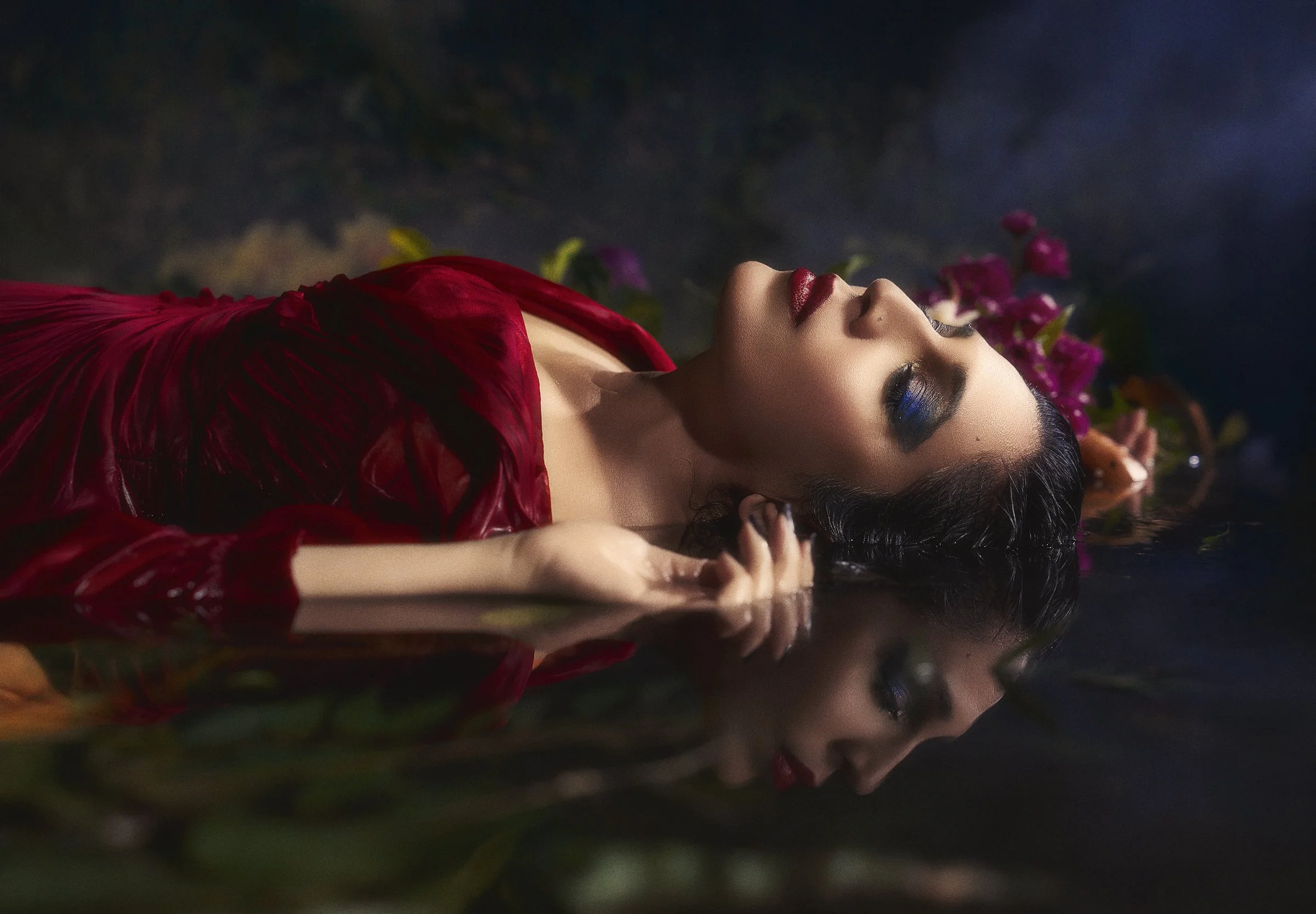
Azam Ali encapsulates many gifts as an artist. Born in Iran, schooled in India and having lived in Canada, the LA-based singer, songwriter, composer, producer and multi-instrumentalist has been named one of the most versatile and gifted singers and composers on the international stage today. Spending her formative years in India allowed Azam to absorb the country’s rich musical and cultural influences, as well as to focus on her school’s emphasis on the arts and spirituality. She moved to the United States as a teenager with her mother in 1985 and immediately began to study the Santour (Persian Hammered Dulcimer). She later realized that through singing she could fully express herself and it set her on the musical journey that has carried her to where she is now. The start of her music career began in 1996 when she founded the world music duo Vas. After releasing 4 albums, the duo parted ways in 2004. She met her husband Loga Ramin Torkian, a fellow Iranian who had immigrated to the United States following the Iranian Revolution of 1979, in 2005 and together they founded the group Niyaz. By incorporating a blend of acoustic and electronic music into their sound, Niyaz’s lyrics combine Arabian and Persian folk sounds with mystical Sufi poetry that conveys the universal struggles of the human soul and experience. She views her life’s work as creating something that transcends religion and culture and to show people that we are all the same. Niyaz has performed in multiple countries around the world and their music has been featured in film and television scores. Azam has collaborated in the studio and on stage with artists such as Serj Tankian of System of A Down, Peter Murphy of Bauhaus, The Crystal Method and Trey Gunn of King Crimson. She has worked with renowned composers such as Christopher Young, Harry Greyson-Williams, Michael Danna and Graeme Revell and her voice can he heard on film and television scores such as ‘Thor-The Dark World’, ‘Matrix-Revolutions’, ‘300’ and ‘The Fight Club’. She most recently worked with David Buckley on an episode of Season 2 of Sandman.
In 2002, Ali began a solo career outside of Niyaz and released her first solo album, Portals of Grace. She went on to produce 4 more solo albums, 2006’s Elysium for the Brave, which reached #10 that year on Billboard’s World Albums Chart, 2011’s Night to the Edge of Day, a collection of lullabies inspired by her son, 2013’s Lamentation of Swans-A Journey Towards Silence, a joint effort with her husband, and 2019’s Phantoms. Over the course of the past decade, Ali has been learning production side of music and carving out her place in the male dominated field of electronic music production. For her fifth solo album, Phantoms, she was responsible for every facet of the album—she composed every song, programmed all the instrumentation, sang every note, and produced the entire album, a rarity in the male-dominated realm of electronic music. “This album is the castle of my dreams. It has transformed me, and opened me up to a new world of self-expression,” she says. On November 14th of this year, Azam released her latest solo album Synesthesia through her new label COP International. Like Phantoms in 2019, it was was written, performed, and produced by Azam and is her second all-English album. The album is named after the sensory phenomenon of synesthesia in which a person can taste colors, feel sounds, or associate certain words or music with specific colors. She released two singles, along with accompanying videos directed by artist Tas Limur, ahead of the albums release- “Synesthesia” and “To Pieces”. She describes “To Pieces” as “a song of destruction, of fire consuming everything in its path, yet within that annihilation lies the threshold of renewal, and the promise of something new”. With regards to “Synesthesia, she says, “My music is an invitation to step beyond the confines of time, place, and the fragile vessel of flesh, into a universe without borders. I want the listener to feel carried into the vastness of the ethereal, where freedom breathes and every note reveals our part in a greater design. In this realm, we are no longer solitary beings, but shining stars drawn together into galaxies, each one a reminder that we are participants in a cosmic symphony far larger than ourselves.”
Having completed and released this latest solo album, Azam has turned her focus to the new multi-media stage production she is helping to create with her band Niyaz for their new upcoming album. You can follow Azam Ali and stay up-to-date on all music, tours, and band announcements, as well as listen to and purchase Synesthesia, via the links below:
WEBSITE | FACEBOOK | INSTAGRAM | SPOTIFY | APPLE MUSIC | YOUTUBE | SOUNDCLOUD
Your new solo album Synesthesia will be released on November 14th. I read that after Phantoms was released in 2019, and then the ensuing pandemic, you fell into a depression and didn't have plans to release another album. How did Synesthesia come about and what inspired you to decide to make another album?
Well, for me, making albums is never really a conscious decision. It is something that evolved so organically. After Phantoms...I had invested so much financially in that album and it really, in terms of what came back, it showed me that in today's world, it's virtually impossible as an artist to earn a living making records. They've basically become very expensive business cards. It just financially didn't make sense. And I'm a mother and have a son who is about to go to university. So that was kind-of depressing for me, realizing that it doesn't financially make sense anymore to make records. And then also realizing that I'm the kind of artist that I am. I felt like I didn't really belong in today's world of being an Instagram artist, a social media artist. I'm not really that kind of an artist. So, unless you are, it's hard to earn a living. That compounded with the pandemic and all of that, it really threw me into a depression. But, music is my sanctuary and I am always writing. I do it for myself. It's a form of therapy, so I just started writing songs. My friend Christian, who owns COP International, is a good friend and lives in the Bay Area. He used to come to LA for work and it became a bit of a ritual where, before he was driving up to Oakland where he lived, he'd just stop by my house in LA and have coffee with me. We would just end up talking for a couple of hours about politics, life, and everything and then on one of the visits he asked me, "Why aren't you making another record?". I said, "I've written a bunch of songs that's really a whole album in itself and kind-of a follow up to Phantoms but I don't think I'll be releasing it. I don't feel like I belong in this world anymore, my music." So, he said "Can I hear it?". I said sure, so we went upstairs and I played him what I had done and he said, "You know what? If you finish this album, I'll fund it and put it out there”. That was a hard offer not to take, so I said ok, because suddenly I had someone supporting me. Christian played a big part in me finishing the album and putting it out. Otherwise, I'm not really sure I would have. And through the course of it, when I was recording and mixing, I would send him texts late at night just crying and thanking him for pushing me to do it. Once the album really started coming together, I felt like what I had on my hands didn't just belong to me. It belonged to others, as well.
It's really such a beautiful album!
Thank you so much. Art is not meant just for the artist. We start to create it for ourselves, but at the end we ultimately create it for others.
How did you decide which songs to release as singles ahead of the album's release?
I kind-of took a poll among friends and Rey Roldan, my publicist- I trust his taste so much. He has impeccable taste, so he played a big part in helping me to choose the songs. As an artist, it's hard sometimes because you have tunnel vision and become attached to songs and it can be hard to choose. I kind-of knew that "Synsesthesia" and "To Pieces" were two magic tracks on there. But, having others reaffirm that was really the reason why those became the two main singles.
Can you talk a bit about the cover art for the album and working with artist Tas Limur on not only the cover art but the videos for "Synesthesia" and "To Pieces"? What was that experience like?
Tas worked with me on Phantoms, as well, and it was an amazing experience. I met Tas through a mutual friend who is an artist, a painter, and I needed to desperately make a video for the title track "Phantoms" on the last record. It was a very last-minute thing and I just reached out to my artist friends and asked if they knew anyone. My friend said, "Yes. This is the guy. His aesthetic and yours are identical, so you need to reach out to him." I sort-of met Tas on a blind date. I hired him and the first time I met him was on set. So that was the music video for "Phantoms", which did really, really well. It was such an easy working experience. So, when I did this album, I reached out to him and said, "Look. I want the entire aesthetic of this album to be your creation." I gave him creative freedom and he asked me what my initial visions were and I just had it constantly in my head, this painting of Ophelia. I thought it would be so amazing that instead of her dying in this painting, what if she lives. I just had this idea for the cover. I wanted everything to be very dreamy and otherworldly, going along with the theme of "Synesthesia". He captured it so perfectly. We worked so hard on that music video and we built the set. It was like old school art creation. We built it with 4 by 4's and a couple of my friends showed up and we built a 10 by 10, like a 6-inch deep pool and flooded it with warm water and hundreds of flowers and leaves. It was the hardest music video I have ever done. Going into that tank was Tas's idea and I'll tell you, I did it and am never doing it again (laughs)! It was so difficult! They make it look so easy, these artists who do these deep water videos. It's such a hard thing to do. The maximum I could float down...I could be down there for 3 seconds, so we had to do a hundred takes of me going down there for 3 seconds. But he did such a phenomenal job. I feel like, aesthetically, the album looks as it sounds and feels. That's what synesthesia is, a coming together of all of the senses.
Could you talk a bit about your own experience with synesthesia?
Mine is actually very mild. I do believe, actually, that everyone has it to a certain degree. I notice it most when people describe and talk about certain songs that mean something to them. It happens to me all of the time. They'll say, "Oh. I listened to this song of yours and I just see this forest." And that's just one example, and that fascinates me, because i feel that something sonic is triggering something visual. So, I think that everybody does have it, to a certain degree, but of course it's an actual medical condition. Some have it very extreme. I have a friend whose son, for example, sees certain numbers, and they give him very intense colors. Certain numbers, when he sees the numbers, it triggers certain colors for him. Mine has to do mostly with velvet. I have a lot of velvet in my closet. Since I was a teenager, I've become obsessed with silk velvet, and I can actually taste it when I touch it and feel it. It crosses into taste. I also have it with scents, where certain scents trigger very visceral memories. I have it more in that sense. Also, sonically, when I create music...music for me isn't just an auditory experience. It's a very spacial experience. I have it more in that sense.
You have a couple of covers on your album- Tim Buckley's "Song To The Siren" and Natalie Merchant's "This House Is On Fire". What is the significance of those particular tracks for you and what led to your decision to include them on the album?
I usually like to do covers, but I'm very careful about which ones I choose. For me, doing a cover does not come from a place of thinking I can perform the song better than the original artist. It really comes from a place of reverence and paying homage to an artist and a song that had a major impact on my own artistic journey. Tim Buckley's "Song To The Siren" has been covered so many times, so I'm not reinventing the wheel by performing it again. I was particularly influenced by Liz Frasier's version of it for This Mortal Coil. I probably, in my late teens, listened to that song maybe dozens of times on repeat. For this album, I really wanted to include a cover of that as a tribute to both Liz Frasier and Tim Buckley. As far as Natalie Merchant's song, that song of hers, when I first heard it, sonically and aesthetically it has gorgeous, gorgeous songwriting and production. She also incorporates Middle Eastern melodies so effortlessly. It's stunning, her version of it. Lyrically, I felt that what she penned, the lyrics she penned, are timeless. It was such a political statement at the time, a social and political statement. Those kinds of honest statements and that kind of truth-telling from artists, for me, are so timeless. I felt that this song of hers, given our current political and social climate, not just in America but globally, is again relevant today. I felt like deserved a new rendition out there to remind people of what I believe to be a very important song.
You have described "To Pieces" as a meditation on betrayal and the wounds we inflict on each other as human beings, as well as nature’s own betrayal and how, within that devastation, lies a threshold where annihilation yields to the promise of something new. Can you talk a bit about that perspective and the ways you feel that humanity is evolving towards something new and is trying to claw our way out of the darkness?
In the last two years, I think we..."To Pieces" was one of the songs I wrote later in the album. The last two years, for me personally, were quite devastating, with the genocide in Gaza and everything happening politically in America. The division. We kind-of, I feel, saw the worst and are still seeing the worst of humanity and the kinds of horrors and cruelty we are capable of inflicting on one another. And not only that, but also ecocide and how are destroying the planet. When I wrote that song, that's really why the video has so much red. I kept seeing red and destruction and fire, and I felt that's kind of the phase we are in. But if we examine nature, when there are wildfires, for example, just within the design of the wildfires, built into it is the design for the renewal and regrowth. That song really became about the destruction all around us, in terms of humanity and also nature, but that within this destruction is also the design for something new. I feel, in terms of politics, seeing what's happening in New York with the election of Zohran Mamdani, and how we brought people of all different religions and ethnicities and identities together, I feel like that gives me tremendous hope. I feel that's a perfect example of how, within the destruction, something new is emerging that is giving us something I think many of us have not had for two years. And that's hope.
It makes you think that maybe things will be ok!
Yes! Absolutely. It's beautiful to see all of the people who are coming together. Mamdani could not have won that election without Jewish supporters. And the fact that everybody came out means that we all recognize that the system that exists, the current system, is not sustainable. Not in terms of humanity or nature. We need to build a new system, and I think just seeing people coming together in NYC has given the entire country, and even beyond that hope. I see messages from all over the world, of people seeing what happened in NY and saying it gives them hope.
You have been very vocal on your platform about everything happening in the world, whether about Gaza, Iran, Afghanistan and beyond, and all of the suffering happening. As someone whose own life has been shaped by war and displacement, and politics, what do you see as your role as an artist in using your music and platform to voice your views and experiences, despite the pushback you have received?
When people tell me, and believe me I hear it a lot, to just shut up and sing and that they don't want to hear about my political and social views and to just "give us your music", I remind them that actually my music is an autobiography of my life. I would not make the kind of music that I am making if it wasn't for the life I have lived. War, displacement, dehumanization, those are all a part of my own lived experiences. And asking me to not talk about that is basically asking me not to express myself as an artist and the full spectrum of who I am. For me, using my platform as an artist to talk about what is happening in the world is part of the exact same truth-telling as the kind of music I write, in which I am being completely, 100% honest in terms of my emotions and the output of what I am expressing. It's the same truth-telling, and I cannot separate the two. And in terms of, especially with the genocide in Gaza, I've felt that how could I possibly just post about mundane things, like what I'm eating or just anything, when there are literally children being killed every single day. And particularly the plight of children is something that is extremely sensitive for me, because I myself was an orphan. I grew up in a boarding school since I was 4, in India. I know what it's like to suffer as a child and to be alone and afraid. So, the plight of children is particularly close to my heart, and if I would not have used my platform, despite all of the push back, I feel that I would have failed as a human being and as an artist.
Do you think that more artists are starting to find their voice, despite the pressure to remain silent, on issues like that?
You know, it's such a personal matter. I do my best not to judge artists when they don't speak out. I'll be honest though-it's hard not to, especially when it's an artist I admire and feel like they are outspoken about some issues but then suddenly become very selective about certain issues. I feel there is a kind-of intersectionality in liberational movements. You can't stand up for LGBTQ rights but then not stand up for other people being oppressed. I feel like we have to apply our morality and our humanity equally across all liberation movements. They are all interconnected. It's hard for me not to be disappointed...maybe that's a better word...in artists I admire, who I feel have a larger platform than I do. I do feel that, perhaps in the last two years, I'm seeing more and more artists speaking out. Perhaps it's because you see others do it and you do find courage in that. I do feel that you find courage. And even if there is a loss, like for me there was a huge loss in the beginning, maybe the first 6-7 months of the genocide, and then suddenly everything just shifted. I found my own people. I found people who cared about what I had to say in terms of that. I remind people, when they say, "Do you feel like it was worth the cost?", that even if you don't feel the cost of it in terms of losing work or money or relationships, there is a cost. It's a cost of the conscience and of the kind of future that we are imagining that we want to build. There is an absolute cost, even if you don't feel it immediately. You have a responsibility as an artist, especially in today's world where media is so biased. We watched an entire genocide live-streamed on social media. This is the future. This is it, you know?
It's pretty staggering for sure.
I know. And the news isn't going to give us the real information. This is how it is from now on, you know?
Blessings to the brave journalists in Gaza, because otherwise we wouldn't really know what's going on.
Exactly. Exactly.
So much of your music is infused with poetry and folktales/folklore, instrumentation, prayers, lullabies, and whatnot from many different cultures...mainly Middle Eastern cultures. Can you talk a bit about using those deep cultural references in your music and your ability to bridge the spiritual, cultural, and musical connections and struggles that you have mentioned feeling intertwined with yourself?
My music, all of it, from the world music I create to my own solo stuff with English, which is a more singer-songwriter approach, is all storytelling. It's a storytelling and an autobiography of my life. I feel, as artists, that we are in a unique position to share with people so many stories. I love the fact that the majority of my audiences are not from any of the cultures whose music I present, but they are all interested and they come. There is something very universal in the overall message, especially when it comes to folk music. I'm particularly interested in folk music of the world, because I feel like folk music is the music of the people. Even in America. When you share that, there is something, even if people don't understand the language. It resonates on a very human level. I'm interested in that and juxtapositioning it against something very modern. Which is kind-of the story of my life, coming from an ancient culture and then finding myself in America and a modern world. And then how do I reconcile these two realities?
Over the years you have done a lot of music for film, television, and video games and were recently a featured vocalist on season 2 of Sandman, having called the experience one of your favorite cues you've ever worked on. What can you tell me about that experience and how it came about, as well as working with David Buckley on the score?
A lot of my work for film and tv, it's not really my vision, and that's why I really like it. It's interesting for me to work with composers and try to capture their vision, because in that process, I feel like I'm going on to become a better artist. My own work is just about expressing myself and my own aesthetic, and sometimes I don't really get what they want, or maybe I'm not enjoying what I'm doing. But every single time I do it, I feel like I come out of it on the other side a better artist. David Buckley is an incredible composer. When he came to me, and once in a while this happens to me, he reached out and said that he had this cue that was, like, three minutes and no dialogue. He said, "I really don't know what to do here. I created this sort of bed of music, but I can't really write the vocal style that you do, and I don't know what to do. So, why don't you take this, and you'll have 100% creative freedom to just sing whatever you want? Just make it multi-layered." He gave me this freedom. He had already created an incredible bed of music, so I wasn't starting from scratch. I had something that was very inspiring already to begin with. And then, I just poured my soul into it, and he loved it, and the producers loved it. It was just one of those rare incidents that happen where you get complete creative freedom, and it becomes a true collaboration. It really was a true collaboration with David.
Can you talk a bit about the collaborative album you are doing with the artist Buckethead, Flowers For The Bees, and how that came about?
Yes. I've known Buckethead for so many years. We met in the early 2000s because we were both on different labels, and Virgin Records bought the labels that we were on. And then they created a small tour for a select group of artists whom they had acquired through their merger. Buckethead was one of them, as well as my last band, Vas. We met on that tour and had four dates in Europe. We travelled together over the course of, I think, ten days or something and immediately bonded. He's such a gentle soul and such a smart, deep-thinking human being, and we just completely bonded. I had no idea who he was before that. We just became friends and then he did a solo album that our mutual friend Serj Tankian produced. Buckethead asked me to sing on that album, so I sang, and then we kind of went our separate ways. Years passed, and then he reached out to me, and he asked if I wanted to do an album together, and I said Sure. It's kind of been evolving, and we have around four songs that are done. It's very slow because I'm very busy and he's very busy. The only way I can describe it is that it's so ethereal, this album. It's mostly just all guitar and voice. I don't think we're really going to have any other instruments. It's very bare bones, with ethereal guitar and voice. In fact, in December, he's performing at The Wiltern in Los Angeles, and he asked me to join him on stage to perform two of the songs, so I am very excited about that. Hopefully, we will finish the album this year and next year we'll get something out there for everyone to enjoy.
You did a run of European shows with Niyaz over the summer. How were the shows?
Those were really great shows. What was interesting is, you know, now we're mostly performing our multi-media project, so when we went to Europe, we went back to sort of our roots of beginning in clubs. It was not the multimedia shows. It was very interesting, after all these years, going back to performing in clubs. It was so much fun, just dancing with people and meeting with people in that very intimate setting, rather than a proper performing arts centre.
What can you tell me about your life outside of music? Are you still making jewellery and doing your fine art prints? And what’s next for you?
Yes. But you know, honestly, my fine art prints...someone just asked me about that the other day. "Why aren't you making any more?". And I thought, what I really loved about that composite work was that it was really hard and would take around ten hours to create an image, taking different photographs and putting them together to create something surreal. Now, with AI art, everything looks like that and it's so hard to...I feel like no matter what I create, it's just going to look as if I created it with AI. So, I've become a little bit jaded, honestly, in terms of visual art. With my jewellery, I'm still making it, but not as much because we are building a brand new multi-media stage production for the new (Niyaz) album. We're actually almost done with the new Niyaz album. We have one more song to record and we're working on a massive stage production, which we are launching in March. All of my energy is right now going into that. It's one of the reasons, also, that I haven't scheduled any shows for Synesthesia, because I really don't have time to tour the album. All of my focus is on this new production. I can't wait to bring that show to the stage, because what we are creating is incredible!
I can't wait to catch a show!